October books

I read two excellent books this month; Yaa Gyasi’s Homegoing and LaRose by Louise Erdrich.  Both are family sagas retelling the stories of several generations. 
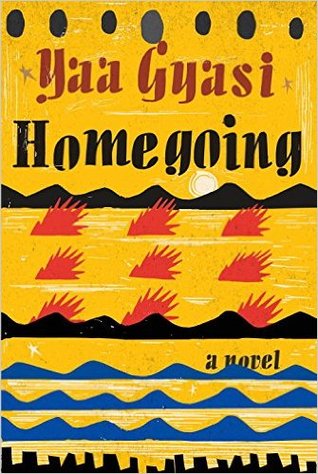
Homegoing traces two half-sisters born into two different villages at a difficult time in Ghana’s history. Tribes are busy waging war against each other and collecting slaves to make money and win favor from the white Europeans. 

Effia is forced to marry an Englishman and goes to live in the Cape Coast Castle. The marriage is a business deal arranged by Effia’s mother to bring fortune to the village and to push her daughter away from the village and her intended husband, the chief Abeeku so that she may have a more profitable life.

Abeeku stood up so that he was facing her. He ran his fingers along the full landscape of her face, the hills of her cheeks, the caves of her nostrils. “A more beautiful woman has never been born,” he said finally. He turned to Baaba. “But I see that you are right. If the white man wants her, he may have her. All the better for the village.” (15)

Effia’s half sister Esi is also promised in marriage to a man in her village. Her father is is a brave warrior, a Big Man, and she’s grown up in being adored by her family and community. One night warriors come to her village and she is told to run into the woods where she sits in a tree but is still found and with pelting rocks hitting her she falls to the ground.


She was tied to others; how many, she didn’t know. She didn’t see anyone from her compound. Not her stepmothers or half siblings. Not her mother. the rope around her wrists held her palms out in supplication. Esi studied the lines on those palms. They led nowhere. She had never felt so hopeless in her life. (43)

And thus both sisters’ fortunes are changed even as both are sold as product. Esi is chained up in the basement dungeon of Cape Coast Castle while her sister lives above. Eventually Esi is shipped off to work the American slave trade. Each chapter relays the tale of a descendent of each sister and in this way you are awarded this amazingly rich historical yet very personal account.

The New Yorker review (I liked it more than they liked it but it does a beautiful job of describing the era)

In LaRose Louise Erdrich gives the reader many parallels to Homegoing’s history. American English did their best to negate both cultures. LaRose, told mostly through the present, tells the story of Landreaux and Emmeline’s grief after a tragic accident kills their friend and neighbor’s son, Dusty. Through back and forth chapters we understand the depth of the grief felt by both couples and through side stories Erdrich interjects the history of Emmeline’s family and how tragedy and wisdom often walk together. The characters Erdrich brings to life are interesting and multidimensional. 


Outside the circle of warmth, the snow squeaked and the stars pulsed in the impenetrable heavens. The girl sat between them, not drinking. She thought her own burdensome thought. From time to time, both of the men looked at her profile in the firelight. her dirty face was brushed with raw gold. As the wine was drunk, the bread was baked. Reverently, they removed the loaves and put them, hot, inside their coats.  The girl opened her blanket to accept a loaf from Wolfred. As he gave it to her, he realized that her dress was torn down the middle. He looked into her eyes and her eyes slid to Mackinnon. The she ducked her head and held the dress together with her elbow while she accepted the loaf. (99)

Both novels illustrate the simple fact that women have been battling men for centuries. How brave and bold it is that we hope to raise our children to accept a different norm.  I know I expect my daughter to be strong and resourceful and I expect my son to treat all women with due respect.

We read LaRose for book club this month and I celebrated by making this Wild Rice Salad. It was delicious and I would make it again. I’ll read anything with Erdrich’s name on it-I love her young reader’s Birchbark House series-and read it with my school book club every year. One of my life goals is to read all of Erdrich’s stories and to make it to her Minneapolis book store.

New York Times review for LaRose.

Happy October!!

Angry Housewives eating Bon Bons by Lorna Landvik

(2003)

A friend from church gave me this book.  She loves to read like me and we have similar tastes in book but I have to admit when she gave me this one I thought it was going to be a shallow girly book but it has far more depth than that.  Actually I can’t say enough wonderful things about this book as I loved the setting (Minnehaha Creek area of Minneapolis), the characters as they were all very distinct, and of course the book club focal point has me excited about a whole list of older (classic) titles.

Synopsis:

The women of Freesia Court are convinced that there is nothing good coffee, delicious desserts, and a strong shoulder can’t fix.  Laughter is the glue that holds them together-the foundation of a book group they call AHEB (Angry Housewives eating Bon Bons), and unofficial “club” that becomes much more.  It becomes a lifeline.  Holding on through forty eventful years, there’s Faith, a lonely mother of twins who harbors a terrible secret that has condemned her to living a lie; big beautiful Audrey, the resident sex queen who knows that with good posture and an attitude you can get away with anything;  Merit, the shy doctor’s wife with the face of an angel and the private hell of an abusive husband; Kari, a wise woman with a wonderful laugh who knows the greatest gifts appear after life’s fiercest storms; and finally, Slip, a tiny spitfire of a woman who isn’t afraid to look trouble straight in the eye.  (back of the book)

To me that just sounded like a lot to take on but it is a credit to Ms. Landvik’s writing that it never goes over a melodramatic top.  Through the group’s book selections as well as how they react to the changing world around them history was shared through the changing point-of-view of each character.

I’ve started a list of books the Angry Housewives read and I’m interested in reading a bit down the list.  Not that I need more books on my to-read list but often the book club conversations intrigued me.

Selected quotes:

As a peace activist myself I could easily identify with Slip; Freesia Court’s resident bleeding heart in 1968.

“I’m sorry,” I said when I was drained of all bodily fluids, “but I just keep asking myself, whatever happened to the Summer of Love?”
“I beg your pardon?” Faith looked like she’d just been asked to explain the theory of relativity.
“You must think I’m some kind of nut, but it’s just…I don’t know, it’s just that I can’t take what’s happening in the world. I can’t take all these people getting shot.  I can’t take this war.  I just thought we were supposed to be better than that.  I really did believe we were on the dawn of a new age.” (63)


Slip’s brother enlists in the Vietnam War but her feelings never waiver as to the unjust war and its aftermath.

And another great quote during a book discussion:

“But I mean this book in particular,” said Slip impatiently.  “This is a hit-you-over-the-head-look-how-different-our-world-is-from-yours kinda book.”
“I agree,” whispered Kari, so as not to wake the slumbering baby in her arms.  “With both of you.  I always love reading about people with lives unlike mine because I get to live in their world for a while.  But the funny thing about reading On the Road is that I didn’t feel their world was so alien…probably because I’m an outlaw too.”
“If you’re an outlaw,” said Faith, “then I’m Granny Clampett.”
We all laughed, but then Slip said, “I’m with Kari.  I feel like an outlaw too.”
“Well, you are,” said Merit earnestly.  “You get arrested on picket lines.”
“Actually, I’ve never been arrested,” said Slip, and I thought I heard regret in her voice.  “But what I mean is that there are outlaws inside all of us-ready to break rules that need to be broken.”
“Right,” I said.  “But society doesn’t want its wives and mothers and PTA presidents to be outlaws, so most of the time we repress that voice that tells us to break the rules, to-” (87)

I find that to be a perfect quote especially for March-in celebration of women’s history!  Thank heavens to many of the outlaw women like Sojourner Truth, and Julia Ward Howe, Barbara Jordan, and Elizabeth Cady Stanton just to name a few.  Cheers to the outlaws and the rule breakers, the makers of change!

As I’ve talked about this book to other reading friends they’ve asked if I’ve read other books by Lorna Landvik and I haven’t but I’m interested.  Anyone else have favorites of this author?  I would love recommendations.  After reading Lorna’s bio I’m wowed by her own life story.