We are all warriors

There is so much in the air, I fear we are all unwell and yet oddly looking at this time through new eyes many of us have a newfound gratitude for our health. My 83-yr-old mother has counted herself  lucky to have avoided Covid for the last two years but tested positive last week after she coughed her way through the Super Bowl. I got a cold around the same time and really hoped it was just a cold but tested positive on Friday. This is my second go round and the vaccination and booster made a big difference in how I feel. My symptoms are more manageable this time. Last time I felt like I would never recover. I didn’t have to be hospitalized although I did end up in the emergency room with pneumonia months after recovering. This pandemic is complicated, confusing, and frustrating and we may never have all the answers. People around me have never had it, never even had reason to take a test and others fall deathly ill. 

My children are warriors for making it through their various situations. Kaylee braved the streets of Brooklyn every day, working from home luckily but still trekking out to breathe and live in the city. Tristan worked through the entire pandemic as many have because his job is not something you can do from home. And Japhy braved her first year of school, both virtually and in-person, and and it has made her rethink everything about why she is going to school. We are all warriors, whether we’ve experienced symptoms or not, as we wind our way through this new reality. 

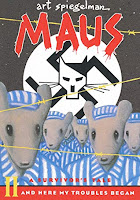
In the midst of this pandemic we have people who feel the need to question books being read by children. As if we don’t already have enough to worry about right now. Russia’s possible invasion of Ukraine seems like something of great importance. But instead some are setting their sights on schools; how we are educating students to be world citizens, and libraries and books that might be too honest about world history or show a naked body.  Art Spiegelman’s 1986 comic book biography, Maus, was recently banned by a Tennessee school district.  After I read the article I checked our district online catalog, found a copy, and read it. It was a very-thought provoking read and a good way for older students to understand a Holocaust survivors story. And check out David Corn’s article in Mother Jones. Please go out an buy a copy or two. 

Why does real history scare people? Why does reading about human relationships scare people? We didn’t conjure up the pandemic by reading a book but somehow reading a book about a gay character might make a teen choose that life style?  This logic makes me question everything as well. How will we move past this puritanical state we are in?  It could take a flood. 

December thoughts

 I recently finished an amazing book, The Overstory by Richard Powers. I completely understand why it was a NYT bestseller and winner of the Pulitzer Prize in Fiction for 2019.  The book is startling good, crisp literature.  It was intriguing to follow nine distinct characters all in their own stories to find how they all connect in some way or another.  I love trees, am a known tree hugger, and get riled up by people who don’t care about simple things like one use items that just get tossed away so this book spoke to me on the level that all our actions should lead us toward a greater good. I’m not a fan of paper napkins, paper towels, cardboard coffee cups, and small plastic beverage containers even though some of this is recyclable or composts naturally as paper does but why buy consumables that are just to be thrown away? It’s just me, I get it, most people don’t think about these things at all. I believe that in certain areas of the country clear cutting forests for profit may be changing as public opinion, research, and natural disasters like mudslides show how groves of trees benefit our habitat as well as animals. Richard Powers does an amazing job of helping us to see the connection between trees and other living beings. “They stand under the circle of camouflaged Platanus, that most resigned of eastern trees, on the spot where the island was sold, by people who listened to trees, to people who cleared them.” (451)  I will remember and treasure the message in the book for a long long time. 

I’m also one and a half chapters away from finishing Ibram X. Kendi’s NYT’s bestselling book, How to be an Antiracist, which I began way back last February. I’m not good with nonfiction. I started reading it with a teacher group through Facebook but I slacked off about chapter 12 and then I was invited to join another book group with two friends and that motivated me to push me through to (nearly) the end. I appreciate Kendi’s writing and his willingness to share his own story with mistakes and racist ideas.  It’s a lot of unpacking and deep thinking and probably a book I will refer back to as I continue to understand our journey better. 

Now as I stay up past my bedtime to write I am mindful of my sleep issues. For eight long years I have struggled with insomnia and waking up in the middle of the night unable to go back to sleep. I don’t feel stressed, I’m in good overall health, and I practice meditation and yoga, drink tea, and generally am not on screens at night. Recently a writer on Twitter that I follow mentioned her own struggles with sleep during menopause and I literally heard an Hallelujah choir sing as I read her comments and others over this issue. I’ve battled this for so long without real understanding from the medical community and found no similar experiences when I discussed it with other female friends! In just one small social media post I felt relief to know that I was not the only one. Thank you Jo Knowles; your simple statement gave me relief, still no solution, but maybe that’s somewhere close at hand as well. Life affirming changes happen through books and even small snippets on social media!  

BLM book list #2

 I started a list on this post – Books give insight– and I have more to add after another few weeks of reading plus a stack that I look forward to reading soon. While protests are still happening across the country our own community has hosted a few community events and peace walks where people are allowed to share their stories. It’s good to listen as a person and as an educator yet I feel like the real people that need to hear the message are in our city councils, police departments,  and other government positions. Our Black mayor was at the last organized Peace Walk. I’m sure he has his own stories from before he took office and during as I know just from reading the paper he has a few foes that stand in his way. 

We have two sister sisters close together and while I happily have my feet in both communities the one I live and teach in does not seem as pro-change and I’m personally trying to figure out how to create good trouble for our new and so far ineffective Mayor Green.  

But let’s segue back to books! For people interested in BLM stories this list gives you a great place to start. Some of my book choices come from The Brown Bookcase an independent bookstore run by 9-yo Rylei and check out The Brown Bookshelf for more inspiration.


1. Dear Martin by Nic Stone (2017) : This YA novel recounts Justyce’s story as he tries to be like his hero Dr. King and finds himself in several unnecessary situations with police including one off-duty officer when the music volume is in question. “Stand your ground” is a terrible law because it gives credence to any average G.I. Joe wannabe who carries a gun.  If you have this mentality that someone is infringing on your own well-being and claim you feel unsafe or just simply anger for being disrespected. Ugh. This book! Too real. Justyce is pre-judged as gangster instead of the good student that he is. We see this happen all the time when we are shown “thug” photos instead of high school grad photos. I’m a new fan of Nic Stone and look forward to reading the next book in this series. 

2. Clean Getaway by Nic Stone (2020) : After reading Dear Martin I quickly put this one on hold at our local library.  This story, more for elementary/middle school, shares Scoob’s journey with his grandmother as she retraces her steps through a few Southern locations using Scoob’s grandfather’s Green Book. His G-ma picks Scoob up for an impromptu road trip leaving Scoob’s dad in the dark. This would make a great read-aloud to help students understand Jim Crow laws and other not-so-subtle rules to keep Black people segregated. 

3. Black Brother, Black Brother by Jewell Parker Rhodes (2020) : Donte, a mixed-race middle schooler, is getting used to a new prep school filled with mostly white students and staff. The first chapter has Donte in the principal’s office defending himself against a teacher who sees him as trouble. His sibling Trey presents as white and has a much easier time at school. This book is not my favorite JPR chapter book but I appreciated the issues raised. It’s maddening as an educator to hear how Donte is treated by people who should be supporting him. This would make a great read-aloud for 5th-7th grade to discuss the inequality of experiences. 

4. Ways to make sunshine by Renee Watson (2020) : I’m in love with Renee Watson’s writing. What I love about this particular story is that while it is realistic fiction; it isn’t a “problem” story.  The biggest “crisis” that happens is that the family has had to move to a new/old rental house because her dad’s postal job was eliminated. So relatable at this time. Ryan has fun with her friends, she goes to a pool party, her grandmother spends hours straightening her hair, she gets into trouble yet she loves her brother, her parents, and her extended family. This is the beginning of a series and I am so excited to read more about Ryan!

and one adult book-

5. A Good Neighborhood by Theresa Anne Fowler (2020) : Valerie Alston-Holt, a professor of forestry and ecology, lives in a beautiful older neighborhood where she raises her mixed race son. While her son, Xavier, was very young he husband died in a tragic accident. Enter in the Whitman family who’ve built a new home and pool and perhaps avoided a few property line codes along the way. Brad Whitman is new money and he’s not concerned about the environment like his neighbor. He only wants to make the three women in his life happy. His downfall is that he has a crush on his teenage stepdaughter Juniper. When Brad and Valerie collide major problems abound. I really couldn’t put this book down. I felt for Valerie as she stands up for what she believes in yet those decisions come with a price. 

Books I’m looking forward to reading soon:


1. Take the mic: fictional stories of everyday resistance edited by Bethany C. Morrow (2019) : A compilation  of major authors contributed stories to this book and I’m excited to see what they have to say. 

2. Count me in by Marsha Bajaj (2019) : This one is about finding an unexpected friendship and how to deal with a hate crime when it happens to you and your beloved grandfather. 

3. Love like Sky by Leslie C. Youngblood (2018) : Another teacher read this and offered it to me. This is a realistic fiction story set in Atlanta. 

And two adult books: 

4. I’m still here: Black dignity in a world made for whiteness by Austin Channing Brown (2018) : This is one I ordered early in April and it took until end of May to arrive. I heard Reese talk about it on her book club website and had to read it. Hopefully I will get to it soon. 

5. Behold the dreamers by Imbolo Mbue (2016) : A friend passed this on and the story which takes place right before and during the Lehman Brothers collapse is about a Cameroonian immigrant living in Harlem.  

Ahhh, so many good books, never enough time. School schedules are starting up. Groovy Girl heads off to college on the 20th. We are all hoping Covid-19 doesn’t affect schools but really I’m just worried. WORRIED MAMA.

**None of these books are linked to a store. I cannot promote Amazon and hope that you can find any of these at a local bookstore, bookshop, or simply from your local library. Have you read any of these on my lists or have other suggestions for me? Let me know via email or a comment. 

The Goldfinch

When we vacationed in Yellowstone with my family this book was on everybody’s list; either they’d read it, reading it (me), or were soon to read it.  Or like my husband who bragged about reading all of Tartt’s books and basically discovering her for the national treasure that she is.  He’s quite proud of his author finds.

The Goldfinch 
Donna Tartt
(2013)

Theo Decker is a 13-year-old boy and he’s in trouble.  He and his mother set off for a meeting at school and when they have trouble in the cab and it begins to rain they stop at the museum for a quick look around.  It’s the stop that changes his life.  As he wanders away from his mother and begins to follow a young girl and her grandfather a blast destroys much of the building, leaving many dead including Theo’s mother.  He spends the next few hours and days bewildered and in shock.

His mother is a gorgeous character that once you meet you don’t want to let go.  Told in Theo’s voice he flatters his mother and lucky for us later reminisces about her.  Tartt makes sure that each character is fully fleshed out and real to us including Theo’s mother or we wouldn’t know what he was missing.

“She looked startled, as if she’d forgotten I was there.  The white coat-flapping in the wind-added to her long-legged ibis quality, as if she were about to unfurl her wings and sail away over the park.” (16)


“Lalloping?” So much of her talk was exotic to my ear, and lollop sounded like some horse term from her childhood: a lazy gallop maybe, some equine gait between a canter and a trot. (17)

After the blast he is sent to live with a very wealthy childhood friend because his father had taken off and his grandparents are really not interested.  He lives for awhile with his friends on Park Avenue for awhile until his dad and his new wife show up to claim him.  His dad’s true interest lies in whatever money or belongings his mother may have left but he’ll take the kid if it will help his cause.  Theo reluctantly packs up and is whisked off to Vegas with his dad and Xandra.  A completely different way of life awaits Theo.

In school Theo makes friends with Boris, a young Russian who also loves to get Theo into trouble.  Boris an amazingly funny character, lovable as the ruffian.  He’s Huck Finn to Theo’s Tom Sawyer. Boris and Theo embark on a drug-crazed odyssey filling their days with drunken conversations about life that center on how bad they have it, how awful their father’s are, and how hot Xandra looks in her work clothes.

Donna Tartt’s wordy yet wonderful novel takes us on quite a journey with Theo as he eventually escapes back to New York and tries to make his way on his own terms.  Yet his past keeps bumping back into him and old ways are hard to slough off. And the painting, The Goldfinch, is present throughout the story as an interesting twist that continually gives both pain and pleasure to poor Theo.

There comes a point in the book where you must just sit and read without answering your phone,  your email, or even eating just so you can help Theo move toward a very shaky but present future.  I finished it now several weeks ago and when I think of Theo and Boris, Hobie and  Pippa all make me smile as I think about how we are all connected.

New York Times review by Stephen King

Huffington Post’s thought by Maddie Crum

The Girl Who Circumnavigated Fairyland In A Ship of Her Own Making

Official Website:  Fairylandbook.com

Groovy Girl, Handsome Husband and I stopped for a quick library visit on Sunday.  We found a few books and had fun wandering together.  Groovy Girl and I had finished up the sixth Sisters Grimm the night before and she was anxiously scanning the Buckley section for the seventh.  It was gone (gasp!) and the nice librarian at the desk put a hold on it for her.

In the meantime I scanned the new elementary fiction section for something inspiring and The Girl Who Circumnavigated... popped out at me on the shelf.  Literally I think it moved a few inches out to attract me.  My friend V and I had recently skyped with our three kids to talk books and this was one we discussed.  She hasn’t been able to get it from the Little Rock Library and here it was popping off the shelf for me.  I tucked it under my arm and hummed just a little.

Mind you, I haven’t finished it so this is not a review per se but Groovy Girl and I have read 4 chapters the last three nights and I’m in love with the writing.  It reminds me of one of my favorite books, Norton Juster’s The Phantom Tollbooth.  The main character’s name is September.  She has conversations with the Green Wind, Latitude and Longitude, two witches named Goodbye and Hello and rides on the back of a flying leopard.  And if that isn’t cool enough the language  is thrillingly descriptive and beautiful.

It was difficult to choose just one but here is a sample:

The Leopard of Little Breezes yawned up and farther off from the rooftops of Omaha, Nebraska, to which September did not even wave good-bye.  One ought not to judge her:  All children are heartless.  They have not grown a heart yet, which is why they can climb tall trees and say shocking things and leap so very high that grown-up hearts flutter in terror.  Hearts weigh quite a lot.  That is why it takes so long to grow one.  but, as in their reading and arithmetic and drawing, different children proceed at different speeds.  (It is well known that reading quickens the growth of a heart like nothing else.)  Some small ones are terrible and fey, Utterly Heartless.  Some are dear and sweet and Hardly Heartless at all.  September stood very generally in the middle on the day the Green Wind took her, Somewhat Heartless, and Somewhat Grown.  And so September did not wave good-bye to her house or her mother’s factory, puffing white smoke far below her. (4)

and this from what we just finished with tonight…

The full moon shone jubilantly as September strode up over the dunes and into the interior of Fairyland with her belly full of witch-cake.  She smelled the sweet, wheat-sugar of sea grass and listened to distant owls call after mice.  And then she suddenly remembered, like a crack of lightning in her mind, check your pockets.  She laid her sceptre in the grass and dug into the pocket of her green smoking jacket. [given to her by the Green Wind]  September pulled out a small crystal ball, glittering in the moonlight.  A single perfectly green leaf hung suspended in it, swaying back and forth gently, as if blown by a faraway wind.  (38)

It is hard for me not to read ahead after I tuck her in…
Sweet Dreams.

The Award-Winning Moon Over Manifest

(2010)
342 pages

I would love to be the kind of person who is able to read the Newberry winner right away or even better, to have already read it before the announcement.  But let’s face it, I have a  busy life with family, school and all the other books on my stack(s).  There is a certain amount of guilt involved as a librarian until you’ve read the Newberry there.  Ahhhh. I feel so much better now and I know the committee made a worthy choice.

When this one was announced it wasn’t even on my radar so I quickly ordered it for my school and then, let it languish around the library.  One day in trying to model good reading to a class I picked it out of a stack and started reading while I wandered among the fourth grade students.  I was hooked. 
Abilene’s voice is strong, clear and interesting.  Here she is getting ready to jump off the train:

At the last car, I waited, listening the way I’d been taught-wait till the clack of the train wheels slows to the rhythm of your heartbeat.  The trouble is my heart speeds up when I’m looking at the ground rushing by.  Finally, I saw a grassy spot and jumped.  The ground came quick and hard, but I landed and rolled as the train lumbered on without a thank-you or goodbye. (3)

Summary from GoodReads:

Abilene Tucker feels abandoned. Her father has put her on a train, sending her off to live with an old friend for the summer while he works a railroad job. Armed only with a few possessions and her list of universals, Abilene jumps off the train in Manifest, Kansas, aiming to learn about the boy her father once was.
Having heard stories about Manifest, Abilene is disappointed to find that it’s just a dried-up, worn-out old town. But her disappointment quickly turns to excitement when she discovers a hidden cigar box full of mementos, including some old letters that mention a spy known as the Rattler. These mysterious letters send Abilene and her new friends, Lettie and Ruthanne, on an honest-to-goodness spy hunt, even though they are warned to “Leave Well Enough Alone.”

Abilene throws all caution aside when she heads down the mysterious Path to Perdition to pay a debt to the reclusive Miss Sadie, a diviner who only tells stories from the past. It seems that Manifest’s history is full of colorful and shadowy characters—and long-held secrets. The more Abilene hears, the more determined she is to learn just what role her father played in that history. And as Manifest’s secrets are laid bare one by one, Abilene begins to weave her own story into the fabric of the town.

Powerful in its simplicity and rich in historical detail, Clare Vanderpool’s debut is a gripping story of loss and redemption.

My thoughts:

The last sentence says it all…It is a powerful tale! It is a gripping story!  One of the reasons I love historical fiction is because there’s a lot to learn while reading and I AM a life-long learner at heart.  This story is special because you get two sets of histories; Abilene’s in 1936 and her father’s in 1918, which Abilene begins to understand as she tries to piece together her father’s part in Manifest’s history. The result is back and forth storytelling brought on by one of my favorite characters, Miss Sadie, a soothsayer or fortune-telling woman of Manifest.  As Miss Sadie tells her remembrances a beautiful picture of Manifest is created for Abiline and her friends. 

If you haven’t had a chance to read this award-winner take the time as it is richly written.

To find this book at an independent bookseller near you, click on the title, Moon Over Manifest

Friday Feature; Poetic Biographies

I’m ending April with some fantastic biographies about poets!  I’ve tried to celebrate poetry all month long by posting poetry on my school blog and by reading poems to students.  I found these stories to be inspiring and thought they earned the right to be featured.  How did you celebrate poetry this month or anytime?

1)  My Name is Gabriela; The Life of Gabriella Mistral by Monica Brown; ill. by John Parra (2005).

Born in Chile, Gabriela had a vivid imagination and taught herself to read because she wanted to read stories not just hear them.  She loved the sounds of words and wrote poetry, songs and stories as a child. Gabriela played school  with her friends and little sister and made them learn their ABC’s and later, she became a teacher as an adult.  She worked hard and was able to travel, exploring and creating new stories along the way.  She was the first Latin American writer to be awarded the Nobel Prize for Literature.  This book contains beautiful illustrations and a happy young Latina charater with an early love of language!

2)  A Voice of Her Own; The Story of Phillis Wheatley, Slave Poet by Kathryn Lasky; ill. by Paul Lee (2003). 

Wheatley’s story is miraculous in many ways.  She was brought to the US on a slave ship, landing in Boston Harbor, at the age of about seven.  John and Susannah Wheatley were at the market looking for a servant girl.  Something about they way the young girl looked appealed to Mrs. Wheatley and they bought her, named her Phillis and took her home.  Luck of the draw…because the Wheatley’s treated her very fairly (within the mind warp that yes, they had indeed bought another human but in this instance it worked out well)  Mrs. Sussanah Wheatly decided to experiment and taught Phillis how to read and write, which wasn’t allowed in Southern states but was perfectly legit in Massuchusetts.  Phillis impressed the Wheatley’s with her ability to write and wanted her poems to be published in a book.  John Hancock and other white American men said her book could not be published.  The Wheatleys sent her to England and someone there agreed to publish it. Yes, Phillis found it odd as well that she would have to travel to King George’s England to get her book published as she was a slave in the US.  The American Revolution began soon after this.  Lasky’s book brilliantly brings to light the indignity that while Americans were willing to fight for their own freedom they owned other people.  This is the backwards rationale we often still find in the United States.  Great book, great message.  Amazing woman.  I wonder what she could have accomplished if she hadn’t been kidnapped and brought to the States. 

3)  A River of Words; The Story of William Carlos Williams by Jen Bryant; ill. by Melissa Sweet (2008)

We all agreed three years ago what a beautiful book this is, even the end papers, showing his poetry!  This is just a great book about an boy who loved the outdoors and the sounds that surrounded him.  In this book is the simple reason to read poetry to young people:  “But when Mr. Abbott read poetry to Willie’s English class, Willie did not feel hurried.  The gentle sounds and shifting rhythms of the poems were like the music of the river.  As the teacher read each line, Willie closed his eyes and let them make pictures in his mind.”   Proof that we need to keep reading poetry to spark one mind into a deep love of language.  Who knows one of your students might be the next William Carlos Williams. 

Pick Up Some Poetry Today and share it with a child.

Yesterday I had a crazy day but part of the craziness involved two different AMAZING Authors…Alan Katz aka Silly  Dilly Man was at my school and Patrick Jennings was at the public library.  I met both and fell in love…see the photos to prove it tomorrow or maybe, Sunday.

What happened to the parents?…prequel will answer burning Boxcar question.

I was so happy to receive this news in an email.  I’ve read many of these books and have often wondered what happened to the parents.  The four children are so resourceful, thoughtful and nice to each other that they had to have had AMAZING parents.

Press Release:

Author of Newbery-winner Sarah, Plain and Tall to Write Boxcar Children Prequel

On Tuesday, March 15, Albert Whitman & Company announced that Newbery-winning author Patricia MacLachlan will write the prequel to The Boxcar Children by Gertrude Chandler Warner. To be published in September 2012, the prequel brings together two powerhouse brands of children’s literature. The book will be published simultaneously as an e-book by Open Road Integrated Media. The announcement was made at the Gertrude Chandler Warner Boxcar Children Museum in Putnam, Connecticut.

Excited to be writing the prequel to The Boxcar Children, MacLachlan is particularly interested in the children themselves. “Henry, Jessie, Violet, and Benny are kind to one another and embody the true sense of family. They are resourceful and positive. I find them both true children and true heroes at the same time. It occurs to me that perhaps their parents were the same. I’m looking forward to exploring that idea and more.”

Patricia MacLachlan, the author of over 20 books for children, won the Newbery Medal for her book Sarah, Plain and Tall.

The Boxcar Children, an award-winning series with over 150 titles and more than 50 million copies in print, has been continuously in print since the publication of the first book in 1942. Albert Whitman will celebrate the 70th anniversary of this beloved series in 2012.

Albert Whitman & Company President John Quattrocchi notes, “Young readers have long wondered how the Boxcar Children came to be orphans. We are pleased and honored that an author of Patricia MacLachlan’s talent and understanding of children will reveal the answer to the world.”

Making the announcement for Albert Whitman & Company was Senior Editor Wendy McClure. Rubin Pfeffer (East-West Literary Agency), MacLachlan’s agent, was also on hand. Representing the museum at the announcement were Fred Hedenberg (Founder and Curator), Patricia Hedenberg (Founding Boxcar Committee Member), and Barbara Scalise (Director). Also present were Bill Pearsall (President, Aspinock Historical Society), Sandra Ames (former grade school student of Gertrude Chandler Warner), and Julia Duquette (former student of Gertrude Chandler Warner and a relative of Warner).
______________________________________________________________________________

I think Patricia MacLachlan is the perfect person to pen this prequel!

The Little Stranger; A Novel by Sarah Waters

My book club picked this for its February read.  It’s a big book at 463 pages for such a short month but it took me less than a week to read it and for me, that’s pretty good.   It kept my interest and I rather enjoyed the lengthy English descriptions but I was left wanting.  Waters purposely never ties up the ends, which left me shaking my head.

The Little Stranger is a detailed story about an old house, Hundreds Hall,  and the Ayres family that lives within.  Our narrator, Dr.  Faraday, the son of a former nursemaid at the house, is called out to the house to examine a young maid and begins a relationship with the family members; Mrs. Ayres, her daughter, Caroline and her son, Roderick.  He’s a country doctor who grew up in the village and visiting the house as an invited guest and doctor is a bit of thrill for him, even though the house has not weathered well.  Something about the family (and the house) intriuges him and he continues his visits to have tea, treating Roddie’s war injuried leg and helping them through one catastrophe after another.  The house is driving the family members mad in one way or another and Dr. Faraday is like this outsider who has a front row seat to the show. 

This is where it gets a bit tricky.  Several incidents are described, leading readers to believe that the old mansion is haunted or cursed, which was creepy and exciting but never explained-just left me on the edge.  I wanted some loose ends tied up.  Part of the intrigue was that the house tormented each family member in a different way.  For Roderick, it played on his insecurities as a landowner/gentleman farmer.  For Mrs. Ayres, the mystery “ghost” was  Susan, the young daughter she had lost before Caroline and Roderick were born.  As for Caroline’s haunt-I leave it a” mystery”-because that one left me more well, mystified than the others.  You’ll have to read it for yourselves and post back to share your own explanations. 
And  Dr. Faraday has some odd pull to the house which did make me wonder once or twice if he was somehow involved. Why does the house never bother him?

Tomorrow night is our book club meeting and I look forward to discussing this story with everyone.  I sometimes try and bring a food item to match with the book.  Last month I brought Baking Soda Biscuits to share for The Widow of the South discussion but this book they don’t dwell on food much-they do drink a lot of tea and cakes but that didn’t seem as fun to me.  I purchased a copy of this from Alibris (a bargain @ $4.00)…just because the library copies were checked out (probably by other members of my bookclub) and PBS didn’t have it listed.    The book now resides on my husband’s side of the bed.  Creepy and mysterious is right up his alley. 

Did I like the book? Yes.
Was I creeped out?  Yes, making it tough to read at bedtime.
I disliked the ending.  My only issue.
What I enjoyed?  The characters and the historical aspect.
Learning more about the class system in England kept me riveted:

Here’s a quote:

The story ran on, Caroline and Roderick prompting more of it; they spoke to each other rather than to me, and, shut out of the game, I looked from mother to daughter to son and finally caught the likenesses between them, not just the similarities of feature-the long limbs, the high-set eyes-but the almost clannish little tricks of gesture and speech.  And I felt a flicker of impatience with them-the faintest stirring of a dark dislike-and my pleasure in the lovely room was slightly spoiled.  Perhaps it was the peasant blood in me, rising.  But Hundreds Hall has been made and maintained, I thought, by the very people they were laughing at now. (25)

Sarah Waters website

Other interesting thoughts on the book:
Wordsmithonia’s review
A Girl Walks Into a Bookstore…
Things mean a lot…

Have you read other books by Sarah Waters?  I did enjoy her style.

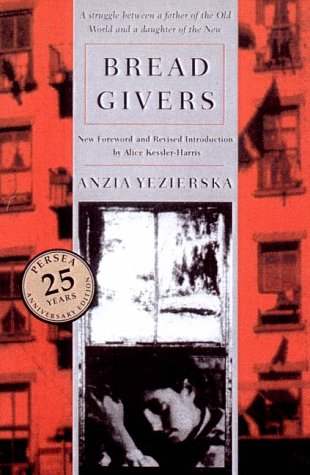
Bread Givers

I purchased Bread Givers by Anzia Yezierska a few years back while my family and I were in Washington D.C.   We toured The Holocaust Museum, which was heartbreaking but  informative and well worth the tour.  Afterward we spent a few minutes browsing the museum kiosk store.  This book’s synopsis caught my attention so I bought it, brought it home and added it to my bookshelf.  Maybe I should have read it right then but I waited four years and pulled it off just recently. 
Snynopsis:  Sara Smolinsky, the youngest daughter of an Orthodox rabbi, watches as her father marries off her sisters to men they don’t love.  The sadness and injustice of their broken lives leads her to rebel against her father’s rigid conception of Jewish womanhood.  “No girl can live without her father or a husband to look out for her,” he proclaims.  “It says in the Torah, only through a man has a woman an existence.”  But Sara replies, “My will is as strong as yours.  I’m going to live my own life.  Nobody can stop me. I’m not from the old country.  I’m American!”  She leaves home, takes a job as an ironer, and rents a room with a door:  “This door was life…the bottom starting point of becoming a person.”  Set during the 1920s on New York’s Lower East Side, the story of Sara’s struggle toward independence and self-fullfillment-through education, work, and love-is universal and resonates with a passionate intensity that all can share. (from the back cover)
My thoughts:  You can see why the book appealed to me.  Sara is an intense character who, as the youngest, watches all these family mistakes play out.  Rather than allow her father to ruin her own life she strikes out on her own, leaving behind her mother, father and sisters.  Her sisters make fun of her even as they complain about the terrible marriages their father has forced them into.  Father’s love of the Torah and studying are completely (for lack of a better word at the moment) CRAZY!  He takes the Torah at it’s word only as it applies to help his cause. 
The struggle between family members, old and new traditions, right and wrong are so fanatical and vivid-I raced home every night to read a few more pages before making dinner.  It made me grateful for my own father who was very forward thinking and giving of his time and thoughts, unlike Sara’s father, who never listens and always talks with bitterness.  Not only were the characters memorable but the language was extraordinary.  This book will stay with me for a long time but only in spirit because as per the Reading From My Own Shelves Project I must depart with it-I’m glad it is going to a good home.  Tina graciously accepted  to take it home with her. 
Memorable quotes: 


and this one from a particular blue day while she is living alone working hard each day to put away money to go to school:
Had a miracle happened?  My father come to see me?  In a rush of gladness words from Isaiah flashed before me as in letters of fire: “I will join the hearts of the parents and the children.”  Never had there been any show of feeling between Father and us children.  Only once a year, on the Day of Atonement, he put his hands over our heads to bless us.  Now, as I looked at him, he seemed to me like Isaiah, Jeremiah, Solomon, and David, all joined together in the one wise old face.  An this man with all the ancient prophets shining out of his eyes-my father.  (she’s so happy to see him even after all the bad)
“Father,” I cried.  An then my voice stopped.  For I suddenly became aware of his cold, hard glance on me.
“Is it true what Max Goldstein said?” His eyes glared.  “Is it true you refused him?”   Not a word could force itself out of my tight throat.  “Answer me! Answer me!”  His voice grew louder and harsher. 
“It wasn’t the real love,” I stammered, hardly aware what I was saying.
“Love you want yet? What do you know about love?  How could any man love a lawless, conscienceless thing like you?  I never dreamed that a decent man would want to  marry you.  You had a chance to make a good ending to a bad play, and you push away such a luck match with your own hands.  I always knew you were crazy.  Now I see you’re your worst enemy.”  (204)
There is so much wonderful in this book-this newer version has a great forward and introduction written by Alice Kessler-Harris, which gave me a lot of insight into Anzia Yezierska’s life.  It’s not often I wax poetic about an intro to a book but it’s a great opening.  I wish this book would be mandatory reading for high school or college.  It’s fits into many different themes: history, gender studies, religion, philosophy, early immigration to the U.S., and  American labor in the 1920’s.  It shows what it was really like to work hard and hope for a better life.  I’m so glad the forces that be made me pick this book and purchase it.  I’m trying to get Teen-age Boy to read it before I pass it over to Tina.  Purchase this classic book from an IndieBound bookstore near year…click on the title to find it-Bread Givers
Whatever you’re reading today-I hope you are enjoying it!  I’ll be reading and lesson planning while the game goes on but if I had to root for a team it would be the Green Bay Packers.  Why?  Because I’ve read about both quarterbacks and Aaron Rodgers wins in my book. 

“I’ll show you how quickly I can marry off the girls when I put my head on it.” “Yah,” sneered Mother. 
 “You showed me enough how quickly you can spoil your daughters’ chances the minute you mix yourself in. 
 If you had only let Mashah alone, she would have been married to a piano-player.”“Did you want me to let in a man who plays on the Sabbath in our family? A piano player has no more character than a poet.”      “Nu-Berel Bernstein was a man of character, a man who was about to become a manufacturer.”

 “But he was a stingy piker.  For my daughters’ husbands I want to pick out men who are people in the world.”
 “Where will you find better men than those they can find for themselves?”
“I’ll go to old Zaretzky, the matchmaker.  All the men on his list are guaranteed characters.”
“But the minute you begin with the matchmaker you must have dowries like in Russia yet.”          
“With me for their father they get their dowries in their brains and in their good looks.”  (71)