We are all warriors

There is so much in the air, I fear we are all unwell and yet oddly looking at this time through new eyes many of us have a newfound gratitude for our health. My 83-yr-old mother has counted herself  lucky to have avoided Covid for the last two years but tested positive last week after she coughed her way through the Super Bowl. I got a cold around the same time and really hoped it was just a cold but tested positive on Friday. This is my second go round and the vaccination and booster made a big difference in how I feel. My symptoms are more manageable this time. Last time I felt like I would never recover. I didn’t have to be hospitalized although I did end up in the emergency room with pneumonia months after recovering. This pandemic is complicated, confusing, and frustrating and we may never have all the answers. People around me have never had it, never even had reason to take a test and others fall deathly ill. 

My children are warriors for making it through their various situations. Kaylee braved the streets of Brooklyn every day, working from home luckily but still trekking out to breathe and live in the city. Tristan worked through the entire pandemic as many have because his job is not something you can do from home. And Japhy braved her first year of school, both virtually and in-person, and and it has made her rethink everything about why she is going to school. We are all warriors, whether we’ve experienced symptoms or not, as we wind our way through this new reality. 
In the midst of this pandemic we have people who feel the need to question books being read by children. As if we don’t already have enough to worry about right now. Russia’s possible invasion of Ukraine seems like something of great importance. But instead some are setting their sights on schools; how we are educating students to be world citizens, and libraries and books that might be too honest about world history or show a naked body.  Art Spiegelman’s 1986 comic book biography, Maus, was recently banned by a Tennessee school district.  After I read the article I checked our district online catalog, found a copy, and read it. It was a very-thought provoking read and a good way for older students to understand a Holocaust survivors story. And check out David Corn’s article in Mother Jones. Please go out an buy a copy or two. 

Why does real history scare people? Why does reading about human relationships scare people? We didn’t conjure up the pandemic by reading a book but somehow reading a book about a gay character might make a teen choose that life style?  This logic makes me question everything as well. How will we move past this puritanical state we are in?  It could take a flood. 

2019 books in review

I’ve read an amazing amount of great literature this year. It was a treat to look back and reminisce about each book on my GoodReads account and it is my hope that I can inspire one reader to pick up at least one of these fabulous books.  I prefer fiction over nonfiction so I surprised myself with three fantastic memoirs this year.  Leonard Pitts has an excellent article “This is the Year of Reading Women” in order to push himself to read more works by women. I am glad to say looking through my lists women authors continue to take a lead for me. 


Nonfiction:

38744839. sy475

Becoming by Michelle Obama

40180047

Shortest Way Home by Pete Buttigieg

35133922

Educated by Tara Westover

7015403

The gifts of imperfection by Brene Brown

26254093. sx318

Better than carrots or sticks; restorative practices for positive classroom management by Dominique Smith

Fiction:

40597810

Daisy Jones and the Six by Taylor Jenkins Reid

36809135

Where the crawdads sing by Delia Owens

36145671. sy475

Salvage the bones by Jesmyn Ward

35297351. sy475

Heads of the colored people by Nafissa Thompson-Spires

35230463

The Bar Harbor retirement home for Famous Writers (and their muses) by Terri-Lynne DeFino

32918898

The Story of Arthur Truluv by Elizabeth Berg

36577586. sy475

Helen Hoang’s book’s  The Kiss Quotient and The Bride Test

37539457. sy475

Sally Rooney’s Normal People and Conversations with friends

39927096. sy475

Less by Andrew Sean Greer

Young Adult/Children’s Fiction:

20873172

Gracefully Grayson by Ami Polonsky

36127488

Front Desk by Kelly Yang

29847473. sx318

Scar Island by Dan Gemeinhart

39217633

Louisiana’s Way home by Kate DiCamillo

22552033. sy475

Look Both Ways by Jason Reynolds

22297138

Summoner Series by Taran Matharu

33158525. sx318

Wishtree by Katherine Applegate

39973

Here Lies the librarian by Richard Peck

32614258. sy475

Walking with Miss Millie by Tamara Bundt

36222611

Aru Shah and the end of time by Roshani Chokshi

30312547. sy475

Amina’s voice by Hena Khan

38185346. sx318

Merci Suarez changes gears by Meg Medina

36086513

Amal Unbound by Aisha Saeed

31702735

Ban this book by Alan Gratz

I’m so gratefully to work in a field where I enjoy the homework very much.  There are so many fantastic diverse authors out there now and I loved what I read in Amal Unbound, Are Shah, and Merci Suarez, Amina’s Voice, Ami Polonsky for Grayson, and Kelly Yang!  I hope 2020 brings as much joy reading.

Friday Feature; Poetic Biographies

I’m ending April with some fantastic biographies about poets!  I’ve tried to celebrate poetry all month long by posting poetry on my school blog and by reading poems to students.  I found these stories to be inspiring and thought they earned the right to be featured.  How did you celebrate poetry this month or anytime?

1)  My Name is Gabriela; The Life of Gabriella Mistral by Monica Brown; ill. by John Parra (2005).

Born in Chile, Gabriela had a vivid imagination and taught herself to read because she wanted to read stories not just hear them.  She loved the sounds of words and wrote poetry, songs and stories as a child. Gabriela played school  with her friends and little sister and made them learn their ABC’s and later, she became a teacher as an adult.  She worked hard and was able to travel, exploring and creating new stories along the way.  She was the first Latin American writer to be awarded the Nobel Prize for Literature.  This book contains beautiful illustrations and a happy young Latina charater with an early love of language!

2)  A Voice of Her Own; The Story of Phillis Wheatley, Slave Poet by Kathryn Lasky; ill. by Paul Lee (2003). 

Wheatley’s story is miraculous in many ways.  She was brought to the US on a slave ship, landing in Boston Harbor, at the age of about seven.  John and Susannah Wheatley were at the market looking for a servant girl.  Something about they way the young girl looked appealed to Mrs. Wheatley and they bought her, named her Phillis and took her home.  Luck of the draw…because the Wheatley’s treated her very fairly (within the mind warp that yes, they had indeed bought another human but in this instance it worked out well)  Mrs. Sussanah Wheatly decided to experiment and taught Phillis how to read and write, which wasn’t allowed in Southern states but was perfectly legit in Massuchusetts.  Phillis impressed the Wheatley’s with her ability to write and wanted her poems to be published in a book.  John Hancock and other white American men said her book could not be published.  The Wheatleys sent her to England and someone there agreed to publish it. Yes, Phillis found it odd as well that she would have to travel to King George’s England to get her book published as she was a slave in the US.  The American Revolution began soon after this.  Lasky’s book brilliantly brings to light the indignity that while Americans were willing to fight for their own freedom they owned other people.  This is the backwards rationale we often still find in the United States.  Great book, great message.  Amazing woman.  I wonder what she could have accomplished if she hadn’t been kidnapped and brought to the States. 

3)  A River of Words; The Story of William Carlos Williams by Jen Bryant; ill. by Melissa Sweet (2008)

We all agreed three years ago what a beautiful book this is, even the end papers, showing his poetry!  This is just a great book about an boy who loved the outdoors and the sounds that surrounded him.  In this book is the simple reason to read poetry to young people:  “But when Mr. Abbott read poetry to Willie’s English class, Willie did not feel hurried.  The gentle sounds and shifting rhythms of the poems were like the music of the river.  As the teacher read each line, Willie closed his eyes and let them make pictures in his mind.”   Proof that we need to keep reading poetry to spark one mind into a deep love of language.  Who knows one of your students might be the next William Carlos Williams. 

Pick Up Some Poetry Today and share it with a child.

Yesterday I had a crazy day but part of the craziness involved two different AMAZING Authors…Alan Katz aka Silly  Dilly Man was at my school and Patrick Jennings was at the public library.  I met both and fell in love…see the photos to prove it tomorrow or maybe, Sunday.

Friday Feature: Women's History Month/Women Who Shook the World!

March is Women’s History Month and while I’m not teaching this specifically with classes I do have three remarkable books that shouldn’t go unnoticed.  I’ve used this timeline with 3rd grade students as we create a black history structure of our own and that is where I noticed the Women’s History Timeline-what a great biography resource tool.

Here are three groundbreaking women:

1. Mind Your Manners, Alice Roosevelt written by Leslie Kimmelman; ill. by Adam Gustavson (2009)

I love this book as much as I love Alice Roosevelt!  She is a fascinating character, filled with spunk and gumption.   This book chronicles Alice’s adventures as her father tries to tame her.  It makes use of speech bubbles to add to its charm-not overdone as too many speech bubbles make it difficult to read aloud.  Find this or order it and enjoy learning more about Alice’s life.  The illustrations are bright and colorful and some almost jump right off the page, especially the snake under the table illustration.    “The secret of eternal youth is arrested development.” ~Alice Roosevelt

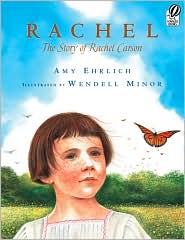
2. Rachel; The Story of Rachel Carson by Amy Ehrlich; ill. by Wendell Minor (2003)

This one is not a read aloud length unless a teacher read it in parts but the Ehrlich’s story is well-written and would be great for 4th-and 5th grade biographies.  Maybe because I’m such a nature freak myself I love the illustrations in this book as much I enjoyed learning more about Carson’s life.  She was interested in writing at an early age and actually had a story published in a magazine at the age of 11.  It wasn’t until she attended college at Pennsylvania College for Women that she found her love of biology.  Carson, with her love of nature, connected the idea of all things being interrelated, a web of life. “If I had influence with the good fairy who is supposed to preside over the christening of all children, I should ask that her gift to each child in the world be a sense of wonder so indestructible that it would last throughout life.”~ Rachel Carson   
Read more about Rachel here.

3. Wangari’s Trees of Peace; A True Story of Africa by Jeanette Winter (2008)

Wangari’s story, one of peace and justice, that I loved hearing about when it first hit the news-one women making a difference in her home country of Kenya.  Wangari studied in America as a young adult and noticed big changes when she retuned to Africa.   Trees had been overharvested , birds no longer sang and crops were scarce.  She begins by planting nine trees in her own backyard, plants many in an open space tree nursery and eventually hands them out to the village women.  This is a woman,  still living, still doing, still campaigning- a great lesson for us all.  There is much too do!  “We are called to assist the Earth to heal her wounds and in the process heal our own-indeed, to embrace the whole creation in all its diversity, beauty and wonder.” ~Wangari Maathai  The Green Belt Movement-for more information.

What about you?  Do you have any amazing books you are featuring for Women’s History Month?  Doing any groundbreaking yourself?

George Washington Carver was amazing!

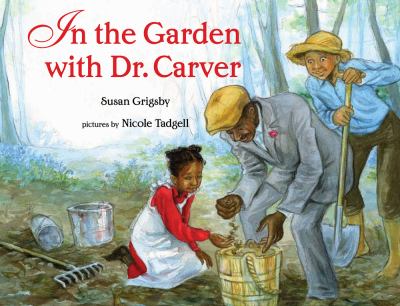
In the Garden with Dr. Carver
Susan Grigsby with pictures by Nicole Tadgell
(2011)

First impression comes from the delicately illustrated endpapers done in a field guide style; identifying plants and animals.  Historical fiction picture books are a great way to introduce important heroes to young children.  This one does just that as it relays Dr. Carver’s idea of a movable agricultural school through the South.  Adults and children learn about healthy soil, crop rotation, the damage cotton does Southern soil and how to do more with the sweet potato and the peanut. 

I loved this book as it took me through an average day with Dr. Carver and his outdoor school.  Oh, I how I long for a similar experience in today’s over processed world.  We could use much of Carver’s knowledge today.  Through his talks he encourages one young girl who wants to grow up to be a plant doctor to “listen to the plants and they will tell you what they need.” 

This would make an excellent resource for budding scientists, plant biology, biographies, black history, animals, gardening and backyard creatures.  I picked it up from my local library but plan to order it for school.  Carver was such an amazing person and we need his knowledge today.  His ideas came to mind yesterday when my husband read me something about the Pepsi Co creating a bottle made from plant sources.  George Washington Carver would be proud of this modern marvel.  If we could create more plastics from plants instead of petroleum we could lessen our dependency on oil in other ways even beyond driving fuel efficient cars.  5/5 amazing stars

Friday Feature/Black History Biographies

I’m trying to be consistent by posting this Friday Feature  before I leave school on Friday afternoons.  Today was an unusual day at school for me and one of our school families.  I can’t go into the details but it greatly affected me.  So this post is late but still done because sometimes consistency is all you have.  Have a blessed day.
I’ve been working with third grade students, cementing the idea that the Underground Railroad is a journey slaves took from the Southern plantations to the North and freedom.  I highlighted six great books last week about slave experiences.  This week I want you to know about four fantastic biographies.  There are biographies that are good for research but I like to see if they make good readalouds.  Unless it is someone a teacher points to or someone already talked about in the history books kids don’t pick up biographies which is sad because we have some beautiful ones.  Oh, unless it is a wrestler, pop star or sports figure, i mean.

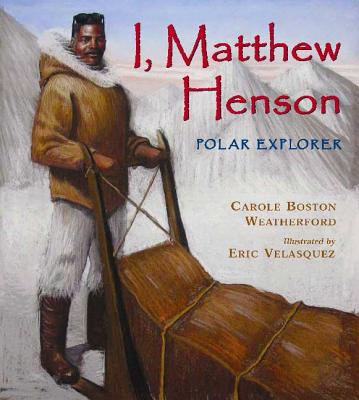
1.  I, Matthew Henson; Polar Explorer by Carole Boston Weatherford; illustrated by Eric Velasquez
I find Matthew Henson’s life story fascinating and when this book came out I was so happy-I thought for sure kids would pick it up just for it’s cover.  I’ve read this one aloud several times and once you read it to kids they love the story.  Matthew, at just 13, walked himself from D.C. to Baltimore to find a ship he could work on and each page reveals another step he took to become Admiral Peary’s right hand man and fellow explorer of Nicaragua, Greenland and eventually the North Pole.  Gorgeous illustrations.

2.  Satchel Paige; Don’t Look Back written by David A. Adler; illustrated by Terry Widener
We are a baseball family.  We love the sport and my husband has all his old cards from when he was a kid.  Often we are disappointed by players mistakes nowadays-Miguel Cabrera-if your reading this my son is so very disappointed in you.  It makes us happy to read stories like this one where Satchel Paige played hard and spoke his mind when confronted with segregation.  A true hero, Paige played for the Mobile Tigers, a semiprofessional black team after serving time in reform school for stealing toy rings.  He eventually become the first African-American to pitch in a World Series game; the Cleveland Indians against the Boston Braves!  Also amazing illustrations.

3. Talkin’ about Bessie; The Story of Aviator Elizabeth  Coleman by Nikki Grimes; illustrated by E.B. Lewis.  This book is especially unique because it tells Bessie’s story from many different perspectives.  Here’s the beginning of  the “school teacher’s”  memories:  “When it came to knowledge, Bessie was a miser, hoarding facts and figures like gold coins she was saving up to spend on something special.”    This fictionized account helps to explain how Bessie became the first female licenced pilot of African descent.

4. Stealing Home; Jackie Robinson against the Odds written by Robert Burleigh; illustrated by Mike Wimmer.  This book is easy to read outloud with a small amount of text to tell thestolen base story but each page includes a baseball card with added historical information.  A sample:  “Jackie’s mother decided to take her family from rural Georgia to Pasadena, California.  All aboard!  Things were better for black people in California than in than in the South.  But not by that much.  The family found it difficult to rent a house.  Food was scarce.  The children were called insulting names.”  Reading this to older kids it would be easy to add in these extra bits of critical information. 

Honorable Mention goes to Visiting Langston by Willie Perdomo for the amazing Bryan Collier’s collage-style illustrations and it’s easy to read style-told from the point-of-view of a young girl who admires Langston Hughes. 

Have a peaceful weekend.
Love yourself and your family.