Laura Amy Schlitz's A Drowned Maiden's Hair; A Melodrama

I’ve been back to work a week and haven’t had a chance to blog all week.  I’m tired every  night and have just enough energy to work with Groovy Girl on homework and get something scraped together for dinner.  I did manage to read this entire charming book one night as a lay awake with insomnia, the night before my return to school.  I loved The Night Fairy by Schlitz and pulled this one off my library shelf and dragged it home in my summer library box.  I love how I grab them out at the ninth hour, just as I’m returning to school to read.  I’m happy I got this one finished though-it will be easy to talk students into reading this just creepy enough chapter book.
A Drowned Maiden’s Hair;
A Melodrama
Laura Amy Schlitz
2006
While this takes place in 1909 I don’t think I would categorize it as historical fiction-it truly is a melodrama! 
Synopsis:

Maud Flynn is living at the Barbary Asylum for Female Orphans and hates it!  She has trouble with authority and dislikes the horrible living conditions.  Lucky for her two nice elderly women come looking to adopt an 8-year-old but pick 11-year-old Maud instead.  At first, Maud is thrilled to be pampered and living in the almost lap of luxury with the three Hawthorne sisters.  There is one catch though and that is she must remain hidden; a secret adopted child, never venturing outside and tiptoeing to her third floor room when visitors come calling.  Eventually her favorite sister, Hyacinth, informs her of the family “business” and why she must remain hidden until they can put her to work as a “dead” child in a seance! 

My thoughts:

This book is a lot of fun.  The premise of the Hawthorne sisters holding seances to convince wealthy clients of their dead relatives desires is definite trickery but when they bring Maud in to play a young girl who drowned it becomes too much to bear.  Maud, as an orphan, craves human love and the idea that the sisters  only have concern for her when she serves their purpose becomes unbearable.  Maud, choosing not to stay completely hidden (her independent streak shines),  meets the grieving mother of the drowned girl, which makes Maud even more contrite as she tries to fight her inner desire for love and the yucky feeling tricking someone brings to her. It’s a twisted tale and you will cheer for Maud as she learns to make some difficult decisions on her own.  I had another ending in mind that involved her brother but I was quite happy with how Schlitz chose to finish Maud’s tale.

Read another review at Becky’s Book Reviews.

Countdown by Deborah Wiles

Countdown
2010

This heavy book has been sitting on my desk looking at me for about 6 months.  I stuck it in my summer box, brought it home, read a bunch of other stuff and it still kept looking at me.  If I’d peeked inside I would have noticed the little typed line…”for the peacemakers,” which would have piqued my interest.  That and the fact that it’s about the 60’s-the early years-should have captured me as well and once I did crack the cover I enjoyed every page-the story plus the memorabilia. 1962-the year I was born and Kennedy and Khrushchev battle it out through many conversations, each one not wanting to back down.

“The price of a gallon of gas rose to 31 cents today.”

And the opening sentence: “I am eleven years old, and I am invisible.”-not because she’s in some deep depression but because Mrs. Rodriquez hasn’t called on her to read-aloud in Social Studies.  Remember when those of us that were good readers loved round robin reading-we were thrilled to be called on and Franny is the same, she is mad and feels like she is being punished by her teacher.  She dangles herself out into the aisle, hoping Mrs. Rodriquez will realize her mistake.

Franny is a strong young female heroine trying to make sense of a world where her family struggles seem as large and confusing as the world struggles with Cuba, nuclear missiles and the idea that she has to be ready to duck and cover to save herself.  You should know this book will make you smarter-it has a lot of history in it-and it will make you understand why peace is so important.

Each of Franny’s family member brings something to this story but much of the action stems from Uncle Otts, a veteran, suffering from shell-shock.  He can’t seem to separate reality from his war experiences especially as the U.S. seems bent on stirring up trouble with Russia and Cuba.  Things keep flashing back for him and I found this story line interesting as we still struggle with this as soldiers come back from Iraq and Afghanistan.

I read around a bit on Deborah Wiles’ website and she’s led and interesting life.  I look forward to others in this three part series.

Friday Feature: Women's History Month/Women Who Shook the World!

March is Women’s History Month and while I’m not teaching this specifically with classes I do have three remarkable books that shouldn’t go unnoticed.  I’ve used this timeline with 3rd grade students as we create a black history structure of our own and that is where I noticed the Women’s History Timeline-what a great biography resource tool.

Here are three groundbreaking women:

1. Mind Your Manners, Alice Roosevelt written by Leslie Kimmelman; ill. by Adam Gustavson (2009)

I love this book as much as I love Alice Roosevelt!  She is a fascinating character, filled with spunk and gumption.   This book chronicles Alice’s adventures as her father tries to tame her.  It makes use of speech bubbles to add to its charm-not overdone as too many speech bubbles make it difficult to read aloud.  Find this or order it and enjoy learning more about Alice’s life.  The illustrations are bright and colorful and some almost jump right off the page, especially the snake under the table illustration.    “The secret of eternal youth is arrested development.” ~Alice Roosevelt

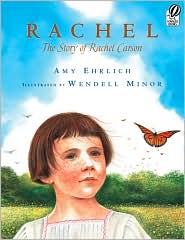
2. Rachel; The Story of Rachel Carson by Amy Ehrlich; ill. by Wendell Minor (2003)

This one is not a read aloud length unless a teacher read it in parts but the Ehrlich’s story is well-written and would be great for 4th-and 5th grade biographies.  Maybe because I’m such a nature freak myself I love the illustrations in this book as much I enjoyed learning more about Carson’s life.  She was interested in writing at an early age and actually had a story published in a magazine at the age of 11.  It wasn’t until she attended college at Pennsylvania College for Women that she found her love of biology.  Carson, with her love of nature, connected the idea of all things being interrelated, a web of life. “If I had influence with the good fairy who is supposed to preside over the christening of all children, I should ask that her gift to each child in the world be a sense of wonder so indestructible that it would last throughout life.”~ Rachel Carson   
Read more about Rachel here.

3. Wangari’s Trees of Peace; A True Story of Africa by Jeanette Winter (2008)

Wangari’s story, one of peace and justice, that I loved hearing about when it first hit the news-one women making a difference in her home country of Kenya.  Wangari studied in America as a young adult and noticed big changes when she retuned to Africa.   Trees had been overharvested , birds no longer sang and crops were scarce.  She begins by planting nine trees in her own backyard, plants many in an open space tree nursery and eventually hands them out to the village women.  This is a woman,  still living, still doing, still campaigning- a great lesson for us all.  There is much too do!  “We are called to assist the Earth to heal her wounds and in the process heal our own-indeed, to embrace the whole creation in all its diversity, beauty and wonder.” ~Wangari Maathai  The Green Belt Movement-for more information.

What about you?  Do you have any amazing books you are featuring for Women’s History Month?  Doing any groundbreaking yourself?

The Lacuna by Barbara Kingsolver

I like this cover even though this is not the version I read. 
Why two such different covers?

I worship at the feet of Ms. Kingsolver’s immense writing skills.  I’ve been a fan since I happened upon The Bean Trees way back in college.  Her books have an earthiness to them and thus highly appealing to me.  I’ve read and enjoyed  most everything she’s written.  The Lacuna scared me at first because of its size…507 pages and also I’d heard many negative reports from friends both in person and in the blogging world.  Many readers looked forward to The Lacuna’s publication date, reserved new copies at the library or ordered them and then abandoned the book half way through.  I was crushed but knew eventually I would pick it up myself.  Luckily a dear friend from my Good Spirits Book Club finished it, praised it and handed it to me to read.  While I can understand why some gave up…I loved it and was once again impressed with Kingsolver’s amazing talent.

GoodReads Synopsis:

     In her most accomplished novel, Barbara Kingsolver takes us on an epic journey from the Mexico City of artists Diego Rivera and Frida Kahlo to the America of Pearl Harbor, FDR, and J. Edgar Hoover. The Lacuna is a poignant story of a man pulled between two nations as they invent their modern identities.

     Born in the United States, reared in a series of provisional households in Mexico—from a coastal island jungle to 1930s Mexico City—Harrison Shepherd finds precarious shelter but no sense of home on his thrilling odyssey. Life is whatever he learns from housekeepers who put him to work in the kitchen, errands he runs in the streets, and one fateful day, by mixing plaster for famed Mexican muralist Diego Rivera. He discovers a passion for Aztec history and meets the exotic, imperious artist Frida Kahlo, who will become his lifelong friend. When he goes to work for Lev Trotsky, an exiled political leader fighting for his life, Shepherd inadvertently casts his lot with art and revolution, newspaper headlines and howling gossip, and a risk of terrible violence.
     Meanwhile, to the north, the United States will soon be caught up in the internationalist goodwill of World War II. There in the land of his birth, Shepherd believes he might remake himself in America’s hopeful image and claim a voice of his own. He finds support from an unlikely kindred soul, his stenographer, Mrs. Brown, who will be far more valuable to her employer than he could ever know. Through darkening years, political winds continue to toss him between north and south in a plot that turns many times on the unspeakable breach—the lacuna—between truth and public presumption.
     With deeply compelling characters, a vivid sense of place, and a clear grasp of how history and public opinion can shape a life, Barbara Kingsolver has created an unforgettable portrait of the artist—and of art itself. The Lacuna is a rich and daring work of literature, establishing its author as one of the most provocative and important of her time.

My thoughts:

I was amazed by the amount of research it must have taken for Kingsolver to create this truly multi-layered work.  Harrison Shepherd drew me into his story, told mostly through journal entries and letters.  His mother, both despicable and human, raises Harrison without any sense of home, always striving for a new and better boyfriend/husband/meal ticket/companion.  She never finds fullfillment in her own life but somehow through her twisted, topsy-turvy life Harrison is satisfied with the simple side of his life.

He  finds solace in writing, keeping a journal of sorts, and allowing life to lead him to work.   I so enjoyed meeting Diego Rivera, Frida Kahlo and Leon Trotsky within the first half of  Harrison’s Mexico story.  I had an inkling of Trotsky’s relationship to Kahlo and Rivera but this book made me want to know more.  I want to go back and watch the 2002 movie, Frida starring Salma Hayek and I’m interested in  Trotsky’s ideas. I wonder if there is other historical fiction that includes Leon Trotsky’s early life in Russia.

The second half of the book takes place in Asheville where Violet Brown picks up Harrison’s thread as she works as his Girl Friday.  Her character brings a new form of friendship to Harrison’s life as she takes care of him like a mother or a sister would, appreciating all of Harrison’s quirkiness.    I loved the depth of this book and enjoyed discussing varying elements with my husband.  If you haven’t given this book a try please do…it has,  for me, put Kingsolver’s work on another literary level. 

Check out Barbara Kingsolver’s website
Find it at an IndieBound bookstore near you…The Lacuna

Other bits about The Lacuna:

The Blue Bookcase
Molly’s Cafe Books
decemberthirty
and Amy at Totally Uninspired

Bill Bryson's The Life and Times of the Thunderbolt Kid; A Memoir

This book has been recommended by many friends and was my book clubs third  reading choice.  I didn’t read it then because I was busy reading other stuff!  I kept putting it off…then when Bibliophile By The Sea presented the Reading off my Shelves Project; this book made my list!  After reading Dreamland by Dessen I need a change of pace.  Jenners from Find Your Next Book Here highly recommended this choice so I picked it up and read it. 
I liked it far more that I thought I would…I’m not a huge fan of memoirs.  It made me think and laugh and I really enjoyed the historical time-travel aspect of Des Moines history.  I felt transported back to the 1950’s; a serene and innocent era of our history.  
Here’s one of the many “expand my knowledge” parts:
“Often, all that was necessary to earn America’s enmity, and land yourself in a lot of trouble, was to get in the way of our economic interests.  In 1950, Guatemala elected a reformist government-“’the most democratic Guatemala ever had,’ according to the historian Howard Zinn-under Jacobo Arbenz, an educated landowner of good intentions.  Arbenz’s election was a blow for the American company United Fruit, which had run Guatemala as a private fiefdom since nineteenth century.  The company owned nearly everything of importance in the country-the ports, the railroads, the communications networks, banks, stores, and some 550,000 acres of farmland-paid little taxes, and could count confidently on the support of a string of repressive dictators.” p. 133
 
He proceeds to inform how United Fruit took care of Jacobo Arbenz.  I loved learning these horrible historical facts  and thought Bryson did an amazing job of researching facts about this time period.  He discussed how  the Atomic Age impacted our lives-the fall-out (in my opinion) is something we are dealing with still!!  Mixed in with all these facts are humorous stories (like the toity jar, p. 19), hysterical looks at his family life and the greater world around him.  I loved the part about his paper route as I had brothers who suffered through the paper route ordeal and having to collect money from neighbors!  Bill Bryson’s website-click here.
As per Project I need to let you know where this one is going-I’m sending it to my brother in Denver, CO, who attended Drake University.  I think he will enjoy Bryson’s wit as well as the history of the city.

Highly Recommended/Memoirs
4/5 stars
Happy Reading!!!