Super Imaginative Picture Books!

I dropped by the library for mere moments the other day and found a plethora of cute picture books on the “new” shelf.

I’ve read them by bits and pieces all through the week and I have three absolute favorites. All three while different have sort of a connection about imagination and comfort.

Naughty Toes by Ann Bonwill; ill. by Teresa Murfin (2011) Tiger Tales
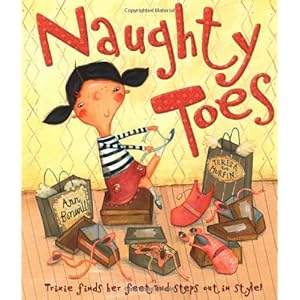
Chloe narrates this tale about life with her perfect ballerina sister, Belinda. She’s not jealous, which is the first thing I noticed and loved. When their mom takes them to the ballet store to pick out leotards and shoes Belinda picks classic pink and white. Chloe picks a wide array of bright colors. The two sisters head to Madame Mina’s dance class where Belinda has “good toes” and Chloe “naughty toes” while Mr. Tiempo keeps the beat on his bright yellow piano. Before the next class Dad does their hair; Belinda’s hair folds elegantly into a beautiful ballerina bun while Chloe’s pokes and struts refusing to be tamed. This illustration is great, showing Dad with bobby pins peeking out of his frown. Back at class Madame Mina gives directions and Chloe continues to flounder. On the day of the big show Belinda gets a bouquet from Madame Mina and Chloe receives a box from Mr. Tiempo- tap shoes with a note that reads…”follow your feet.” The message is clear and abundant. Every character in the book celebrates their own path. Chloe’s never scolded for marching to the beat of a different drummer. Each parent participates in their own way.
This is a perfect score!

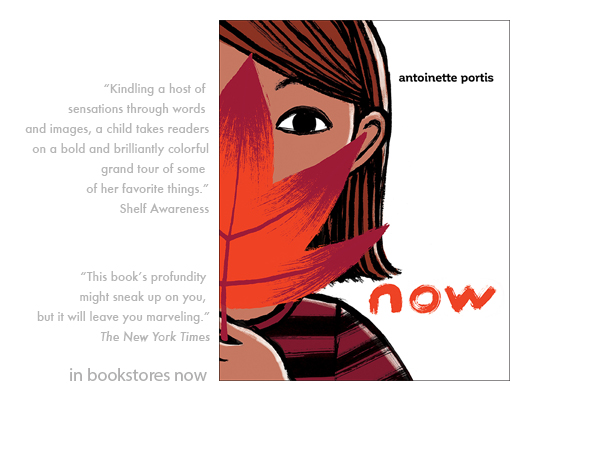
Princess Super Kitty by Antoinette Portis. (2011) Harper.

Simply narrated by a little girl with short cropped dark hair who is pretending to be a kitty.  My own children did this often, asking for food on the floor, as they purred and scratched their way around the house.  Most memorably my two oldest loved to pretend they were wolves.  Oh, those were the days.  Such an abundance of imagination!  This young girl shifts from kitty to Super Kitty, ready to save the world by rescuing her baby brother.  She even delivers his bottle in “zero seconds”.  Super Kitty quickly morphs into Princess Super Kitty as she marches around the house for her family to adore.  Each new character allows her the freedom to make a new choice about doing something helpful like taking a bath or playing nicely with her brother.  From the tone we can easily hear that she is not a demanding or shrill princess character.  I adore Portis’ other books, Not a Stick and Not a Box and this is another one to add to my collection.
Goodnight Dragons by Judith L. Roth; ill. Pascal Lemaitre (love his work!). (2012) Hyperion Books.

This is a “boy” book filled with wonderful imaginative play.  This little guy wants to tame dragons so he gathers his tools and fills his wagon.  He traipses off to the forest with his trusty “horse” dog.  The book at this point hadn’t stirred my creative soul just yet but then this line hit me:  “With a voice strong as hawksong, I call them to me.  Come you heartbreakers.  Come, you brokenhearted.  Come put your fire with sweet chocolate milk.”  he repeats peeking through the treetops.  That line is magical to me-this little boy in the trees, offering comfort to the dragons, who come swarming for his call.  Instead of sword play he offers them blankets, and a sleepy time treat.  Magic.  Simply shows how little boys can be nurturing and creative as well.

Sprinkle these extremely peaceful stories into your bedtime routine for lots of hugs and love!

Friday Feature; Using our Imaginations with Peter H. Reynolds

Author/Illustrator/Creative Inspiration Peter H. Reynolds
This week has been a crazy week at our house.  I haven’t made a real dinner all week except for Wednesday (organic burgers and butterfly pasta), which we ate on the fly, heading to a dramatic production of my husband’s.  Otherwise we have had a mix of soccer, track and other school events.  Blogging (obviously) has taken a back seat but I’ve had a fun week at school so I have to share.

At the end of every school year I spend time talking about imagination, trying to get kids pumped up to use theirs during summer break.  I started off the conversation with “What are good, fun things to do in the summer?” Sure enough the first little one to raise his hand answered “play all my video games.”  as if he was planted in my pint-sized audience.  I dramatically *gasped*, made my face look like this .  We then talked about staring at the television and video games and went on to share good things to do in the summer, like play outside.

One of the points I make is that it’s okay to do those things in small doses just as it is okay to play on the computer every once in awhile. the trick is to make it worthwhile-by playing thinking games or imaginative games.  This week I paired a set of playful books with the author’s website to demonstrate imagination.

The Dot by Peter H. Reynolds (2003).  Vashti sits in her art class with a blank piece of paper; she can’t think of anything to draw.  Her art teacher inpires her to just make a mark on the paper and then asks her to sign it.  When Vashti arrives in art the next week she is thrilled to find her marked and signed paper, framed, and hanging by the teacher’s desk.  Vashti then goes on to make even better dots and eventually pays it forward by helping another young boy to make his mark.  This small book packs a huge creative message. 

Ish by Peter H. Reynolds (2004).  Similar artistic message here with an added dose of stick-with-it-ness.  Ramon loves to draw until his older brother, Leon, laughs at him.  Ramon is frustrated because, while he loves to draw, what he draws does not turn out perfect.  His little sister, Marisol, teaches him that sometimes they look enough “like” the object and that is good enough.  This one does take a lengthy discussion about what “ish” means for students to get it; otherwise they think of “ish” as being closer to “ick”, which is not the message you want them to walk understand. 

The coup d’etat after the books is to share Reynolds’ mastermind FableVision Place with students; although I “force” them to play the art game first then go to the other buildings.  Invariably they all end up at the arcade and isn’t that what summer’s all about!

Saraswati's Way

2010
233 pages, including glossary

I love to get books directly from the author.  Monika Schroder contacted me and asked if I would read and review her book and I casually replied “Yes, I’d love to…”  and at that point you never know how it’s going to turn out but the book was wonderful.  I especially loved learning more about Indian culture and I fell in love with Akash and his passion for learning. 

Summary:    Leaving his village in rurual India to find a better education, mathematically gifted, twelve-year-old Akash arrives at the New Delhi train station, where he relies on Saraswati, the Hindu goddess of knowledge, to guide him as he negotiates life on the street, resists the temptations of easy money, and learns whom he can trust.

Akash’s story demonstrates how difficult in many cultures it is to become educated and even though the United States has a public school system we experience the same; if your family does not value education that fact alone will make it hard to be a good student.  Akash has been in school but his math knowledge exceeds his teacher’s and he needs to locate and pay for a math tutor so he can pass the a test and get a scholarship to get into a good high school.  His father believes in Akash’s education but when his father dies his grandmother is quick to send him off to work in the rock quarry. 

After only a few days at the rock quarry Akash has the chance to “see” the ledger keeping all the accounts for the quarry.  When he realizes it will take him years and years to pay off his grandmother’s debt he chooses to run away.  He knows he has what it takes to change and his desire is to be educated.  Jumping a train to Delhi Akash is hidden by a portly train employee.

In Delhi he doesn’t know anyone and ends up sleeping in a box through the night.  While he’s taken himself out of one bad situation (rock quarry) he quickly finds living on his own has its drawbacks. He has to deal with other boys fighting to stay alive, police, and drug dealers.  While Akash makes some good decisions and some bad ones he learns to keep his focus on finding an education.  On the train platform he eventually meets Ramesh-ji who runs the magazine stand.  He lets Akash sleep on top so he isn’t bothered by the police officers in the night.  Ramesh and Akash build a good relationship, realizing there is more to each of them than one would think. 

Three Quotes:

Other street boys befriend Akash and teach him the ways of the station.  They all have ways to deal with their homelessness and hunger. 

“I will fly away,” Deepak said, fluttering his arms. His face distorted to a horrid grin.

“Are they okay?” Akash asked.
“I told you,” Rohit said. “The glue makes you see things that are not there.”
“At first,” Sunil said. “Then it makes you drowsy and when you can’t stop it turns your brain into glue.” (31)

and

“How come you didn’t go to the movies?” Ramesh asked.  “Isn’t it Friday today?”
“I didn’t want to go.  I need to save my money for a tutor.  I found a man at Pahar Ganj who will teach me math.”
“That is very wise of you,” Ramesh-ji said, suddenly speaking in English.
“Ramesh-ji, I didn’t know you spoke English.”
“Maybe you would like to practice your English with me.  For the kind of school you want to go to, you need to speak, read, and write English well.  Didn’t you even bring an English textbook?”
“How do you know English?” Akash asked.
“I used to work as a cook for British people,” Ramesh said. “That was a long time ago.” (35)

Schroder does a great job of intergrating Indian culture so anyone reading will have learned from their experience…

Akash would have like to accompany him to the temple, but since Ramesh didn’t offer to take him, he didn’t dare ask.  Navratri, the nine nights before Dussehra, had always been one of his favorite festivals.  In the evenings he had joined the other youths from the village to watch the dandia dance.  The men would form a circle on the outside and the women one in the inside.  When the music began each cirle started to rotate slowly in opposite directions.  (34)

I loved reading this book and couldn’t wait to see how Akash dealt with the street boys and the drug dealers, especially when he decided to become a courier to make some money.  It is an intense story and I was cheering for Akash to get back on the right path.  Luckily his deep desire for an education does win out and Akash and Ramesh find a way to work together. 

This is a perfect middle school mulitcultural read.  Thank you to Monika Schroder for sensing my need to read her gem.  To find it at an Independent bookseller near you, click on the title…Saraswati’s Way


Friday Feature; Poetic Biographies

I’m ending April with some fantastic biographies about poets!  I’ve tried to celebrate poetry all month long by posting poetry on my school blog and by reading poems to students.  I found these stories to be inspiring and thought they earned the right to be featured.  How did you celebrate poetry this month or anytime?

1)  My Name is Gabriela; The Life of Gabriella Mistral by Monica Brown; ill. by John Parra (2005).

Born in Chile, Gabriela had a vivid imagination and taught herself to read because she wanted to read stories not just hear them.  She loved the sounds of words and wrote poetry, songs and stories as a child. Gabriela played school  with her friends and little sister and made them learn their ABC’s and later, she became a teacher as an adult.  She worked hard and was able to travel, exploring and creating new stories along the way.  She was the first Latin American writer to be awarded the Nobel Prize for Literature.  This book contains beautiful illustrations and a happy young Latina charater with an early love of language!

2)  A Voice of Her Own; The Story of Phillis Wheatley, Slave Poet by Kathryn Lasky; ill. by Paul Lee (2003). 

Wheatley’s story is miraculous in many ways.  She was brought to the US on a slave ship, landing in Boston Harbor, at the age of about seven.  John and Susannah Wheatley were at the market looking for a servant girl.  Something about they way the young girl looked appealed to Mrs. Wheatley and they bought her, named her Phillis and took her home.  Luck of the draw…because the Wheatley’s treated her very fairly (within the mind warp that yes, they had indeed bought another human but in this instance it worked out well)  Mrs. Sussanah Wheatly decided to experiment and taught Phillis how to read and write, which wasn’t allowed in Southern states but was perfectly legit in Massuchusetts.  Phillis impressed the Wheatley’s with her ability to write and wanted her poems to be published in a book.  John Hancock and other white American men said her book could not be published.  The Wheatleys sent her to England and someone there agreed to publish it. Yes, Phillis found it odd as well that she would have to travel to King George’s England to get her book published as she was a slave in the US.  The American Revolution began soon after this.  Lasky’s book brilliantly brings to light the indignity that while Americans were willing to fight for their own freedom they owned other people.  This is the backwards rationale we often still find in the United States.  Great book, great message.  Amazing woman.  I wonder what she could have accomplished if she hadn’t been kidnapped and brought to the States. 

3)  A River of Words; The Story of William Carlos Williams by Jen Bryant; ill. by Melissa Sweet (2008)

We all agreed three years ago what a beautiful book this is, even the end papers, showing his poetry!  This is just a great book about an boy who loved the outdoors and the sounds that surrounded him.  In this book is the simple reason to read poetry to young people:  “But when Mr. Abbott read poetry to Willie’s English class, Willie did not feel hurried.  The gentle sounds and shifting rhythms of the poems were like the music of the river.  As the teacher read each line, Willie closed his eyes and let them make pictures in his mind.”   Proof that we need to keep reading poetry to spark one mind into a deep love of language.  Who knows one of your students might be the next William Carlos Williams. 

Pick Up Some Poetry Today and share it with a child.

Yesterday I had a crazy day but part of the craziness involved two different AMAZING Authors…Alan Katz aka Silly  Dilly Man was at my school and Patrick Jennings was at the public library.  I met both and fell in love…see the photos to prove it tomorrow or maybe, Sunday.

What Should I Make?

by Nandini Nayer
illustations by Proiti Roy
(2009)

     This book was originally published in India, in English and in Hindi.  Neeraj’s mother is making dough, rolling it into chapatis and hands him some dough to play with.  Neeraj is a cute boy with hair going everywhich way and he takes that dough, uses his imagination and makes all kinds of creatures. 
“Neeraj rolled th edough back and forth, back and forth, into a long rope.  At one end of the rope, he poked two tiny eyes.  The other end became a pointed tail.  ‘A snake!  A snake!'”

     Even though we never see all of Neeraj’s mother we can tell she is dressed in a flowing green sari and with bangles at her wrists.  She has few lines in the book as well but they are playful as she encourages him to play with the dough.  I’m happy the author choose to make the main character a boy, crossing the stereotype of girl’s helping mother’s in the kitchen. 

     I love the heck out of this book, especially the back section, which provides directions for making chapatis.  The recipe is simple and I think we will make them some time soon.

She’s Too Fond of Books loved this book as well.

     On the other end of the spectrum we read an awful picture book during storytime.  The cover is attractive but it ends there.  This book scared Groovy Girl right before sleeping.  Should I have to preview books before bedtime? No. The illustrations are like clay puppets; think Coraline in the “other world”. The second disturbing thing was the text is scrawled in cursive.  She was supposed to be reading it to me but she handed it to me and said “I can’t read that!”  I said but you are learning cursive…She said “Not like that.”  So I read and well, we finished it but are both unhappy for it.

  The Look Book: Two siblings are bored on summer break and their mother sends them outside.  Outside they see different things, in contrast. 
One page:
“Ann saw a whole pie.” 
Next page:
“Ian saw a pie hole.”

farther along:
“Ian saw a car get towed.”
“Ann saw a car get a toad”  (picture of blood stained road after the car has passed)
“Ian saw a bird soar overhead”
“Ann saw a bird with a sore head.” ( an axe in a stump next to a chicken head, a chicken’s body running in front of Ann)
After many weird and scary homonyms they return home and tell their mother they saw nothing…there I’ve ruined the end for everyone.   This is a perfect book for someone with a wry or slightly twisted sense of humor. Creative-Yes, Perfect storytime book-Nay!

The images and the text are disturbing and I’m not sure who made the decision to market this for children. Boo.
If It’s Hip, It’s Here has another take on the book.