The Nix by Nathan Hill

I really am ready for spring! I need the snow and ice to melt and the temperature to rise. I want to see green shoots peeking out of the rough ground. I know here we still have a long way to go. 

Reading is one of the ways we get through the long winter and during the month of February I’ve spent a lot of quality time with one book-The Nix.  Just me and 732 pages of writing from Nathan Hill. It’s a good thing I liked it. It’s long with lots of characters and a variety of twists and turns. There is A lot going on in this novel. 
Most of the plot lines center around Samuel, a professor at a small midwestern school.  His mother abandoned him as a boy and now as an adult she’s suddenly in the news for throwing rocks at a presidential candidate.  Samuel would rather just ignore it except for the book publisher who knows there’s an interesting story there.  We travel back in time to see his mother, Faye, as she leaves her small Iowa home with her disgruntled parents behind as she embarks on a new stage of her life in Chicago. 
In between we meet a cast of characters from Samuel’s and Faye’s early life and travel as far away as Norway.  We meet gaming friends and learn about this complex world of Elfscape as we watch Samuel deal with a humorous yet cheating college student who has an unusual grasp of how the world should work. So much going on yet I was never confused. Everyone’s lives are multilayered and every story, every offshoot matters in this tale. 
It reminded me of A Little Life by Hanya Yanagihara because of its length and detailed writing. Here’s a sample of detail from The Nix:

So that day he felt like he needed to cry. He told his mother he was going to his room to read, which was not unusual. He spent most of his time alone in his room, reading the Choose your own adventure books he bought from the bookmobile at school. He liked how the books looked on the shelf, all together like that, homogenous, with their white-and-red spines and titles like Lost on the Amazon, Journey to Stonehenge, Planet of the Dragons. He liked the books forking paths, and when he came to a particularly difficult decision, he would hold the page with his thumb and read ahead, verifying that it was an acceptable choice.  The books had a clarity and a symmetry to them that he found mostly absent in the real world. (83-84)

I’ve already added it to my shopping list for upcoming birthdays and holidays. This is Nathan Hill’s first published novel and he seems like a bit of character himself. I listened to this interview to learn more. Give it a try; any good novel is worth the time you put into it and this one is a huge success for Mr. Hill.


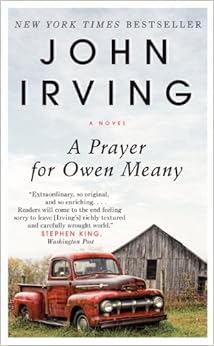
John Irving, master storyteller

My eyes were blurry and yet I kept reading.  I just wanted to finish and find out how Owen Meany died.  It’s a critical question in the book as the last half is focused on the fact that Owen knows when he is going to die based on a recurruing dream he has.  His best friend John is in the dream as well as a group of Vietnamese children.  Owen has trouble with the details but he is certain enough that he carves his own gravestone marker at his parent’s quarry.  To be that certain that your dream is accurate, to be so certain of your faith are all part of Owen Meany’s character-that and his crazy voice.

It’s not an easy book to finish. I feel all of February has been dedicated to this book and usually in that amount of time I can get at least 2-3 books finished.  Not so with a John Irving novel.  My friend Sue picked this for our book club selection this month and I was glad as I’d never read it.  My husband and another friend Tim both pick this as one of their favorites.  After the first 10 pages I wasn’t so sure-I especially disliked the super long chapters-and I pushed through that only to really fall in love with the story.  It has so many great connecting ideas and what it has to say about faith and friendship are great reminders to us all.

Thank you Sue for making this a book club pick and for a great book club discussion.

I heard a little “amen” in Owen’s voice when I shouted “I finished” last night.

I heard there is a movie.  Anyone watched it?

Also two very different covers…I prefer the armadillo version myself.

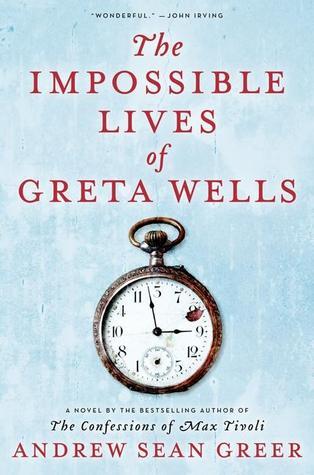
The Impossible Lives of Greta Wells (Andrew Sean Greer)

My friend Teri and I trade novels back and forth.  She’s a bookie like me and we share a similar taste in stories.  She gives them to me with notes that say things like “I need this one back” or “pass it on”.

The Impossible Lives of Greta Wells (2013) by Andrew Sean Greer is one she wants back and I think its because she wants to reread it!  It’s confusing and while I enjoyed Greer’s writing I don’t think rereading is going to help me.

Told in alternating chapters the story starts in 1985 and transporting us back to 1941 and 1918.  In 1985 Greta suffers from depression after her twin brother Felix’s death, and her lover Nathan leaves her for another woman. She tries a radical treatment under the supervision of her doctor that sends her back in time and she experiences her life from that angle.  In the other two lives her brother Felix is still alive but soon to marry or married to the wrong person and Nathan is there also.  It is very interesting to see what occurs in the alternating years with each year having a glimpse into aids, WWII, and the flu epidemic.  Greta thinks this is a way for her to be able to fix things, help her brother be comfortable in his sexuality mostly, and eventually she realizes that while she is working one angle there are 2 other Gretas making other plans.  Because each is working on their own ideas every once in awhile they get stuck in a time period and it isn’t until she realizes ultimately she can’t make changes no matter how she attempts to bend the rules.  Life has its own plan.

While I don’t want to go through psycho-therapy I would love the chance to wake up in another time period to experience what life has to offer.  How interesting to see the same friends and lovers just as they say we do in past lives.  Trippy.  

I enjoyed reading this review in the NYT by David Leavitt explaining the in’s and out’s of Greta’s time travel psycho-therapy.  I’ve heard Greer’s book The Confessions of Max Tivoli also looks at time from an interesting perspective as Max ages backwards.  I would love to give it a try.

The Yonahlossee Riding Camp for Girls by Anton Disclafani

Synopsis:


It is 1930, the midst of the Great Depression.  After her mysterious role in a family tragedy, passionate, strong-willed Thea Atwell, age fifteen, has been cast out of her Florida home, exiled to an equestrian boarding school for Southern debutantes.  High in the Blue Ridge Mountains, with its complex social strata ordered by money, beauty, and girls’ friendships, the Yonahlossee Riding Camp for Girls is far remove from the free-roaming, dreamlike childhood Thea once shared with her twin brother on their family’s citrus farm-a world that is now lost.
As she grapples with her responsibility for the events of the past year that led her here, and what they will mean in the grand scheme of her life and her relationship with her family, Thea also finds herself enmeshed in a new order at Yonahlossee.  Her eyes opened for the first time to a larger world, she must navigate the politics and competition of friendship as well as her own sexual awakening, and come to an understanding of the kind of person she is-or wants to be.  Her experience will change her sense of what is possible for herself, her family, and her country.

What I liked:  The mountain setting is as beautiful as Thea’s look back at her life in Florida and her family stories.   I enjoyed learning more about the Depression from this unique viewpoint as a few of the wealthy young ladies were affected and were forced to leave the camp.  I enjoyed Thea’s love of horses and riding. Disclafani’s distinction of “bad girls” vs. “boys will be boys” was well played and reflects what still exists today all though probably not AS bad.  I enjoyed the twist of how her notion of what was originally meant to be punishment turns out to be her saving grace.

What I didn’t like:  Thea was a tough character which made it hard to love her.  I can’t say more without revealing important elements of the story that are best kept secret until you pick it up to read it. While she wasn’t easy to like there was much to enjoy in this story.

A sample:

I slipped away to the barn one afternoon, when all the other girls were studying at the Hall.  Now instead of bird-watching, botany, and painting we had history, literature, and home economics; math and science didn’t seem to exist in this mountain enclave.  We didn’t have much homework, either, or nothing that took very much time.  I like literature, unsurprisingly, taught by bland Miss Brooks.  She became impassioned, though, when referring to books she loved, and watching her I sometimes thought, isn’t that always the way?  A dull girl charmed by a book? (119)

Find her here Anton Disclafani’s website and on twitter.