June book reviews for YOU (happy reading)

I’ve only read three books this month. They were really good books though.  Technically I finished four but the Bill Browder book, The Red Notice, was a crossover from May. I’ll still tell you about it though.

1.  The Red Notice; a true story of high finance, murder and one man’s fight for justice by Bill Browder (2015): Born into a communist-leaning family Browder grows up seeing what it is like to rebel against the norm but to rebel even further Browder chose a career path profession just to annoy his dad; he picks commerce.  The first half of the book Browder tells his family story and how he rose to be the first major investor of Western money into Russia and the second half of the book deals with the downfall of this great plan and the imprisonment and eventual death of his friend and lawyer, Sergei Magnitsky.  I enjoyed this memoir, even though I thought Browder wasn’t the greatest story teller. Reading this book gave me a clear mindset on why Putin felt the need to tangle himself into U.S. elections and will continue to torment and push buttons just because he’s found a way.
2. Eragon by Christopher Paolini (2003): Tristan read this years ago and devoured the series. I’ve always wanted to read it but who knows why? I didn’t pick it up until this summer after 2 teachers raved about it to me after a teacher meeting. They were shocked that I hadn’t read it; That was the push I needed so I brought it home that very last week of school. I loved it. I dig fantasy and this book was no exception. Eragon, Brom, Saphira, Murtagh and Arya were all interesting characters and I look forward to reading the next two in the series.  Even though Paolini was young when he wrote this I think it stands the test of time.
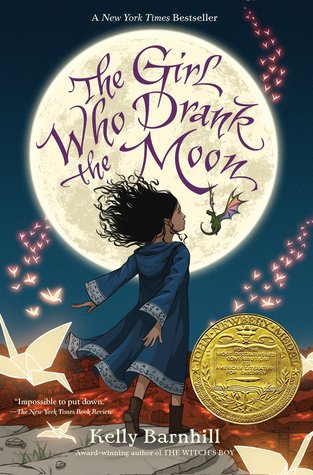
3. The Girl who drank from the moon by Kelly Barnhill (2016):  I loved this fairy tale {and that gorgeous cover art} in which Xan and Luna save themselves and change the world together.  Centuries ago a world was created by evil people and the unwitting townsfolk believed the stories that were told to them about an evil witch who needs a sacrificial baby each year so as not to destroy the town. Xan is this witch but she rescues the babies and takes them to new families because she thinks they’ve been abandoned.  And so it goes for many years until one family fights back and one mother doesn’t give up hope. A good reminder, from a fairy tale world, to not believe all that you are told!  Read more great things about this book at NYTEW, and the Washington Post.

4. American War by Omar El Akkad (2017): I read a NYT article about great new dystopian books and this one was at the top of the list. Like fantasy, I’m a big fan of the altered worlds created in good dystopian novels. This one lacks the gruesome gore of The Hunger Games but certainly lays out how a fight over energy and ravaged ecosystems could separate the North from the South in a way that causes longterm war within our own border. Read other great reviews here on NPRSF Chronicle, and the Washington Post. I’m not quite finished with this one yet and plan to finish today.

In Madison I did purchase several books and I have stack of books to read for school. What are you reading this summer?
Girl at war by Sara Novic`

School is winding down and my desk is full.  I’m grading, collecting books, and preparing for an-end-of-the-year book fair.  My head is spinning maybe because I spent part of my week laying on the sofa reading Girl at War instead of getting stuff done.  It was worth it though; this is a great book.

Ana Juric`, a ten-year-old living in Croatia’s capital has had a happy childhood until civil war breaks out and her life is transformed by food rationing, soldiers,  and air raid drills.  Suddenly life is very different and she feels out of control. The daily peace she felt is replaced with fear and uncertainty except when she is nestled together with her family:

That first time we saw it, my mother and I together, she patted my shoulder because these men were protecting Croatia and the fighting didn’t look too dangerous. She smiled and the soup steamed, and even Rahela wasn’t crying for once, and I allowed myself to slide into the fantasy I recognized as such even while my mind was still spinning it- that there in the flat, with my family, I was safe. (29)

The war circles around the Juric` family but at home there is a greater concern.  Ana’s younger sister, Rahela, is sick and needs medical attention.  After visiting a female doctor in Zagreb Ana’s family makes the difficult decision to get Rahela transported out of Croatia to America where she will recieve the treatment she needs. As Ana and her parents mournfully drive back to Zagreb they are stopped by a roadblock of Serbian soldiers.  It is at this moment that Ana’s life will be forever changed and as it is with tragedy it makes her into the womas we later meet in New York.

Her predictable life studying in NYC has her on edge and she can’t accept all that has happened to her.  She is at war with herself, trying to resolve what she experienced.  She makes a rash decision to travel back to Croatia to see if friends are still alive and to make peace with how her life has been shaped.

This is a transformitive story.  I enjoyed Ana’s voice, her family struggles in New Jersey, and the difficult time she has with feeling comfortable after living, surviving a war where so many died.  Girl at war shows how resilent we are while making us fully aware of the damage caused by tragedy and war. It is a story of survival.  And we all need to read more of that.

It also brought to light this conflict for me.  In my small town we had an influx of Bosnian residents during this conflict.  They’ve succeeded in our community in many ways, been accepted and embraced, but it also makes me wonder what lies underneath.  Thank you,  Ana,  for this reminder; realizing the harm we do while fighting wars abroad and on our own streets would be a worthy reason to keep the peace.

On sale: May 12th, 2015 (go buy it now)

Thank you to @DavidEbershoff at Random House for my copy. My time-wasting habit of scrolling around twitter totally worth it when I’m able to scoop up an excellent book. It also in no way altered my review of this book.  I loved it all on my own.

Museum of Thieves (great little chapter book)

I bought this one awhile ago at the Fall Scholastic Book Fair and catalogued (one of the talents I have as I have a Library Science degree) it into the library.  I read a few pages and knew it was going to be good.  Then I set it down and went about my business.

I picked it back up two years later.  None of the kiddos were reading it so I had to investigate further and I loved it.  I’m ready for the second one to come around, which upon investigation is out and so is the 3rd one!  This is the bonus of reading books before you recommend them; this morning I had a student come in looking for something “mysterious”-I handed her this one and told her to give it a try.

Synopsis:

Welcome to the tyrannical city of Jewel, where impatience is a sin and boldness is  crime. Goldie Roth has lived in Jewel all her life.  Like every child in the city, she wears a silver guardchain and is forced to obey the dreaded Blessed Guardians.  She has never done anything by herself and won’t be allowed out on the streets unchained until her Separation Day.


When Separation Day is cancelled, Goldie, who has always been both impatient and bold, runs away, risking not only her own life but also the lives of those she has left behind.  In the chaos that follows, she is lured to the mysterious Museum of Dunt, where she meets the boy Toadspit and discovers terrible secrets. {back cover}

I have post-it notes littered throughout the book of quotes I just couldn’t resist:

But she (Olga Ciavolga) was smiling when she turned back to Goldie.  “But there are some things, child, that you should steal, if you have enough love and courage in your heart.  You must snatch freedom from the hands of the tyrant.  You must spirit away innocent lives before they are destroyed.  You must hide secret and sacred places.” {122-123}


There are different sorts of fear, she (Goldie) realized that now.  There was the fear of having a musket held to your head, or having black oily water try to snatch you into its depths.  There was nothing easy about that fear.  It made your heart nearly tear itself out of your chest, and weakened the long bones in your legs so that you could barely stand.  It made you want to vomit with fright.
But there was another sort of fear, the fear that you would never be allowed to be who you really were. The fear that you true self would have to stay squashed up, like a caged bird, for the rest of your life.  That fear was worse than any soldier.  {179}

and one more…

“The museum should never have become so full of wild and dangerous things,” said Sinew.  “But the people of Jewel are like Guardian Hope, with her planks and hammers.  They tried to nail life down.  they wanted to be completely safe and happy at all times.  The trouble is, the world just isn’t like that.  You can’t have high mountains without deep valleys.  You can’t have great happiness without great sadness.  The world is never still.  It moves from one thing to another, back and forth, back and forth, like a butterfly opening and closing it’s wings.”  {197}

Goldie is a brave young girl who listens to her inner voice which takes her places she’d have never thought to venture otherwise.  Her and Toadspit try to think through how to solve the problems they face.  They are surrounded by interesting adults who guide them.  What’s not to love??

Lian Tanner’s Website-with games for the museum!
Random House fun website for this series.

Happy Friday!

Code Talker by Joseph Bruchac

Code Talker
Joseph Bruchac
2005
224 pages

Kii Yazhi is six years old when he is taken from his mother, from his land to go to boarding school governed by the United States.  His uncle drives him there in a wagon and gives him this advice:

Little Boy, he said, Sister’s first son, listen to me.  You are not going to school for yourself.  You are doing this for your family.  To learn the ways of the bilagaanaa, the white people, is a good thing.  Our Navajo language is sacred and beautiful.  Yet all the laws of the United States, those laws that we now have to live by, they are in English. (8)

Boarding school takes away their beautiful Navajo clothes, their symbolic long hair, their language, and even their names.  Kii Yazhi becomes Ned Begay. His school journey begins and ends with disrespectful and mean teachers yet he survives and does well.  He chooses to follow the rules and gets sent on to secondary school.  He is 16 when war breaks out and he wants to enlist but waits until the next year with his parent’s permission.  The U.S. Marines have a special use for Navajo enlistees and he is able to be specially trained to send codes using the exact language he had been beaten for using at boarding school; a wonderful twist!

The story is told from Begay’s memory as he shares with his grandchildren.  Ned’s journey shares such an overlooked part of history; one that I knew about but only on the barest surface.  Bruchac inserts such wisdom among the awful horrors of boarding school and the war.

You know, grandchildren, for a long time even after the war, it was hard for me to have any good thoughts about the Japanese.  What troubled me the most was the way they treated the native people of the islands they conquered.  They believed only Japanese were real humans.  Anyone else could be treated like a dog.  Never forget, grandchildren, that we must always see all other people as human beings, worthy of respect.  We must never forget, as the Japanese forgot, that all life is holy. (148)

This is great historical non-fiction and I plan to use it this year with a boy’s book club.  They will love the war element and I will love that they are looking at it from a different angle.

Forge (2010) by Laurie Halse Anderson

     Did you read Chains (2008) by Halse Anderson?
Oh, it was a good read!  I liked it because it was a serious look at the Revolutionary War through the eyes of Isabel, a slave.  What a perfect paradox: Americans fighting for their freedom from King George while enslaving Africans into intense labor. 

Good Reads Summary:

     In this compelling sequel to Chains, a National Book Award Finalist and winner of the Scott O’Dell Award for Historical Fiction, acclaimed author Laurie Halse Anderson shifts perspective from Isabel to Curzon and brings to the page the tale of what it takes for runaway slaves to forge their own paths in a world of obstacles—and in the midst of the American Revolution.
   The Patriot Army was shaped and strengthened by the desperate circumstances of the Valley Forge winter. This is where Curzon the boy becomes Curzon the young man. In addition to the hardships of soldiering, he lives with the fear of discovery, for he is an escaped slave passing for free. And then there is Isabel, who is also at Valley Forge—against her will. She and Curzon have to sort out the tangled threads of their friendship while figuring out what stands between the two of them and true freedom.

My thoughts:  I have to admit at first I was a bit disappointed with the heavy focus on Curzon and all the fighting.  I missed Isabel’s character and the mystery and intrigue of the first book, but as I kept reading I enjoyed learning about the Valley Forge experience. I did not know, for example, that the soldiers had to build their own cabins in the snow.  Curzon’s story follows the battles closely and they end up at Valley Forge. He is constantly tormented by some of his fellow soldiers and yet, remarkably, he manages to maintain his dignity throughout. Thankfully Isabel eventually comes back into Curzon’s life, demonstrating how tenous life is for both of them, rounding the story out nicely for me.
     This is a perfect book to help young people understand the horrors of war, slavery and the importance of friendship throughout adversity.  I’m now anxiously awaiting the third installment, Ashes , in Halse Anderson’s Seeds of American series.

Some books I have to really search for the perfect quote to share, not so with Halse Anderson’s work because every page has something worth sharing.

Random Quote: 

The last lad was John Burns.  His rude  manner declared him my enemy the first time he clapped eyes on me.  Burns had white skin that turned red when he was angry (a frequent condition), dirt-colored hair that never stayed tied back in a queue, and small eyes like a badger’s that were forever seeking a way to avoid work.  He spat at my feet whenever I walked by.  He accused me of stealing my new hat.  He said the crudest kinds of things about my parents and grandparents, and he convinced the Barry brothers to join him in his foulness. (54)

Read Abby (the) Librarian”s review.
Find the author’s website and blog here-Laurie Halse Anderson
Enjoy this great article (Publishers Weekly/Shelf Talker) about a school visit

I’m an IndieBound affiliate. 
Buy Forge from an IndieBound